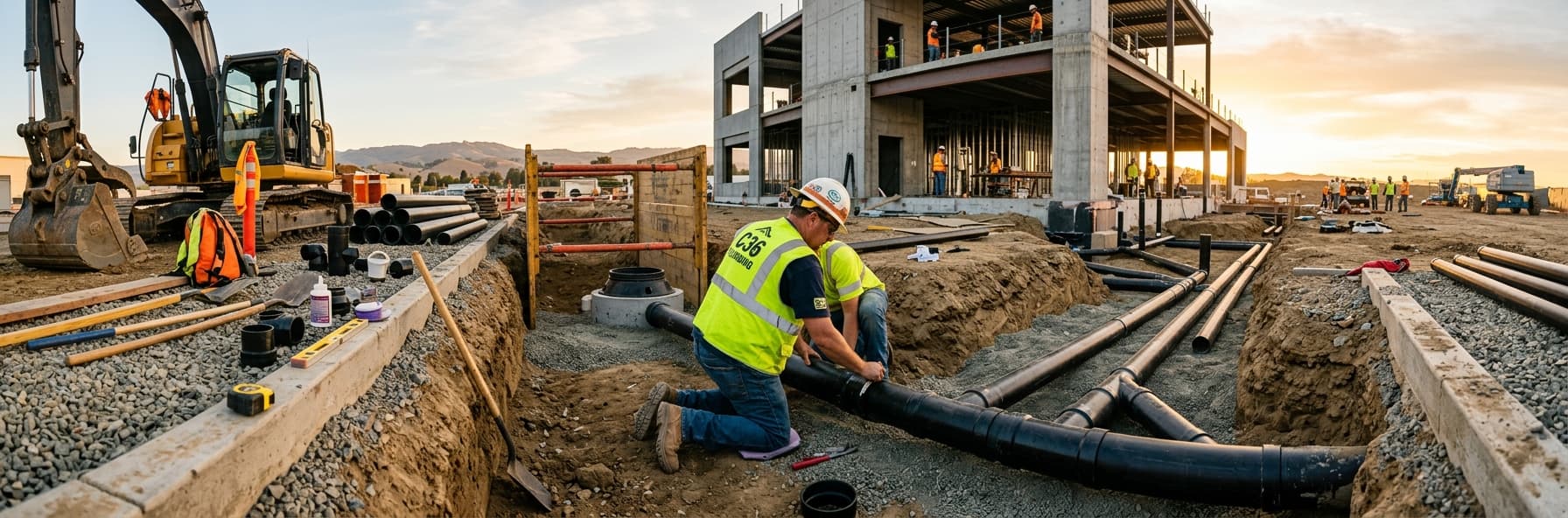

# Underground Building Sewer Installation and Sizing: CPC Section 702 Requirements for C-36 Exam Success
Building sewer sizing represents one of the most critical competencies tested in the California Plumbing Code drainage systems portion of the C-36 examination. CPC Section 702 establishes the foundational requirements for underground drainage installation that every licensed plumber must understand thoroughly. This comprehensive guide walks you through the essential concepts, calculations, and code requirements you'll encounter on exam day.
Understanding CPC Section 702: The Foundation
CPC Section 702 specifically addresses building sewer sizing and defines the parameters that determine pipe diameter, slope, and capacity. The California Plumbing Code drainage requirements in this section stem from the International Plumbing Code but include California-specific modifications that candidates must know precisely.
The primary purpose of Section 702 is to ensure that underground building sewers can adequately convey wastewater from the building to the point of disposal (septic system, public sewer, or treatment facility) without backup, overflow, or damage to building foundations.
Key Definitions from CPC Section 702
Building Sewer: The extension from the building drain to the public sewer or private sewage disposal system. It includes all portions outside the foundation wall. Fixture Unit (FU): A standardized measurement representing the probable discharge of wastewater from a single fixture. CPC Section 422 provides the complete fixture unit table that directly correlates to Section 702 sizing requirements. Drainage Load: The total number of fixture units connected to a particular drainage system, calculated by summing all connected fixtures.Understanding these foundational definitions prevents common exam errors where candidates confuse building drains (inside the building) with building sewers (outside the building), which requires different code references.
Fixture Unit Calculations: The Starting Point
Before you can size any building sewer according to California plumbing code drainage standards, you must accurately calculate the total drainage load in fixture units.
Standard Fixture Unit Values
The CPC Section 422 Table provides fixture unit allocations:
- Toilet: 4 FU (3 FU for low-consumption models)
- Lavatory (sink): 1 FU
- Bathtub/Shower: 2 FU
- Kitchen sink: 2 FU
- Washing machine: 2 FU
- Floor drain: 1 FU
- Water closet (bidet): 1 FU
Exam Tip: Common Fixture Unit Mistakes
Candidates frequently make these errors on exam questions:
- Counting low-flow toilets as 4 FU instead of 3 FU—read the fixture specifications carefully
- Forgetting floor drains in basements or mechanical rooms—these count toward drainage load
- Misinterpreting shower stalls vs. bathtubs—both are 2 FU, but shower stalls can sometimes carry different ratings in specific scenarios
- Assuming all fixtures are equally loaded—CPC allows for simultaneous use factors that reduce calculated loads in certain residential situations
Calculation Example
A residential home with:- 2 toilets (3 FU each) = 6 FU
- 3 lavatories (1 FU each) = 3 FU
- 2 bathtubs (2 FU each) = 4 FU
- 1 kitchen sink (2 FU) = 2 FU
- 1 washing machine (2 FU) = 2 FU
- 1 floor drain (1 FU) = 1 FU
CPC Section 702 Sizing Table Requirements
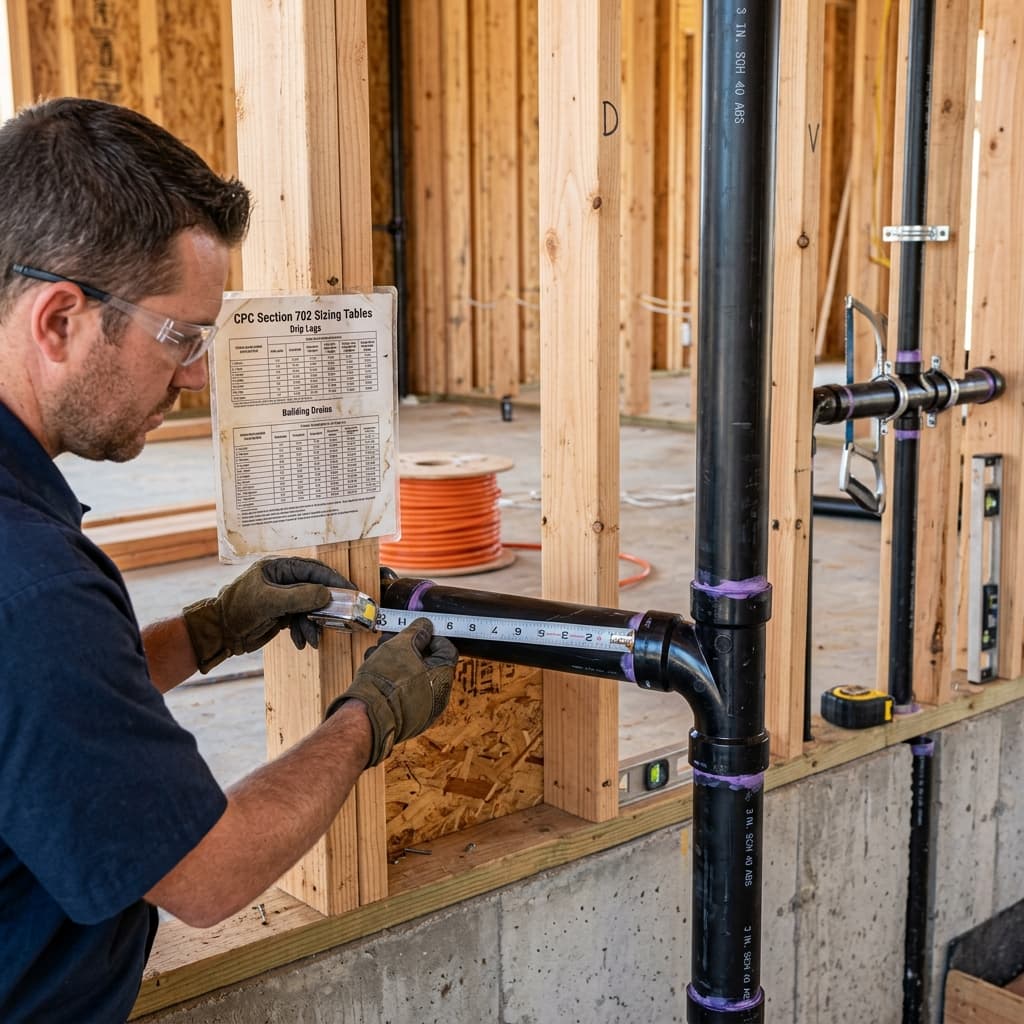
Once you've calculated fixture units, CPC Section 702 provides tables correlating fixture units to required pipe diameter and slope. This section of the code is straightforward but requires memorization for exam success.
Building Sewer Sizing Based on Fixture Units
| Fixture Units | Pipe Diameter | Minimum Slope | |---|---|---| | 1-3 | 1.25" | 1/4" per foot | | 4-6 | 1.5" | 1/4" per foot | | 7-10 | 2" | 1/4" per foot | | 11-20 | 2.5" | 1/4" per foot | | 21-50 | 3" | 1/4" per foot | | 51-100 | 4" | 1/8" per foot | | 101-200 | 5" | 1/8" per foot | | 201-500 | 6" | 1/8" per foot |
Critical Exam Point: CPC Section 702 requires minimum slope of 1/4 inch per foot for pipes up to 3 inches diameter. Larger pipes (4 inches and greater) can use 1/8 inch per foot slope. This distinction appears frequently on exam questions.Installation Requirements for Underground Building Sewers
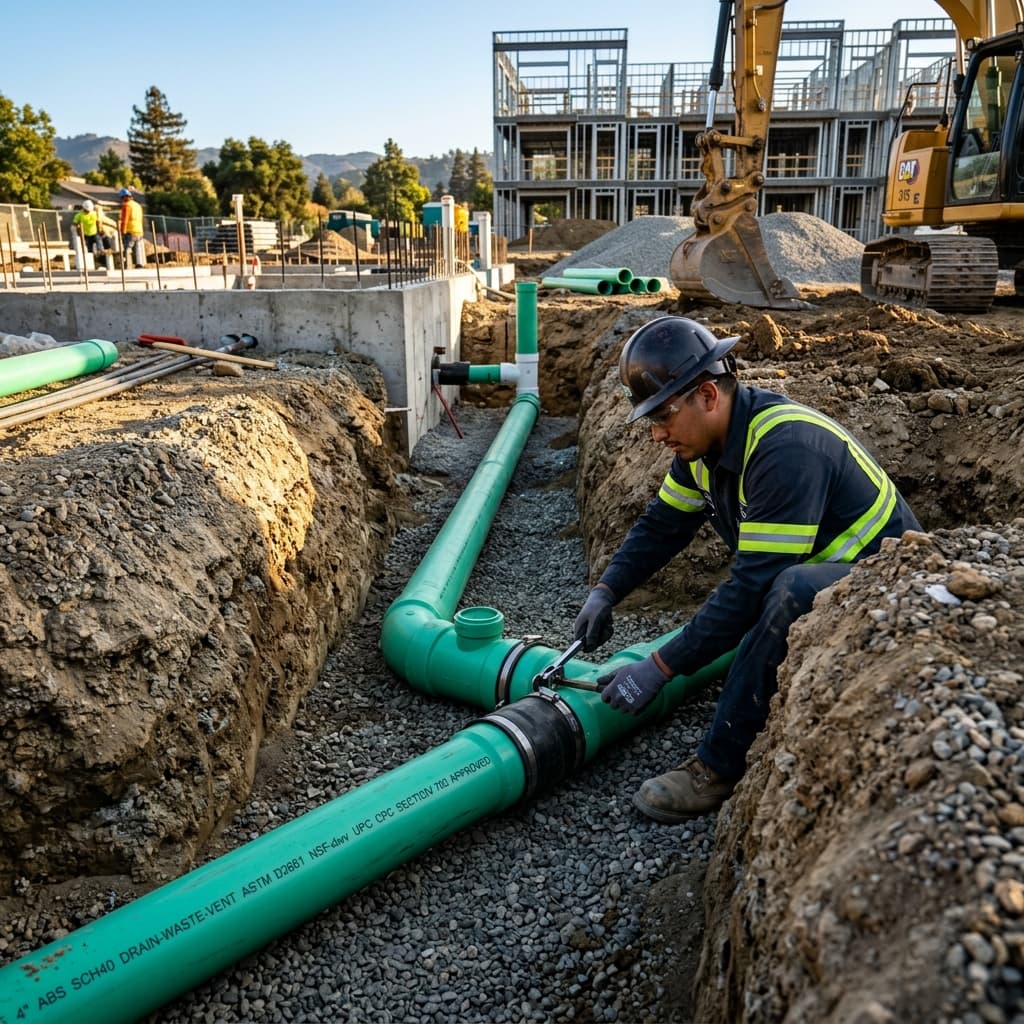
Beyond sizing calculations, CPC Section 702 and related sections (particularly Section 703 on materials and Section 704 on installation) establish specific underground drainage installation standards.
Minimum Depth Requirements
Building sewers must be installed at sufficient depth to:
- Protect from freezing: Minimum 3 feet below grade in most California locations, though depth varies by climate zone
- Avoid damage: Protected from vehicle loads and surface disturbance
- Prevent surface water infiltration: Proper slope and sealing prevent groundwater entry
Material Requirements for Underground Building Sewers
CPC Section 703 specifies approved materials:
- Clay pipe (vitrified clay pipe/VCP)
- PVC pipe (most common in modern installations)
- Cast iron pipe
- Copper pipe
- Asbestos cement pipe (older systems)
- Concrete pipe (typically for larger commercial systems)
Bedding and Support Standards
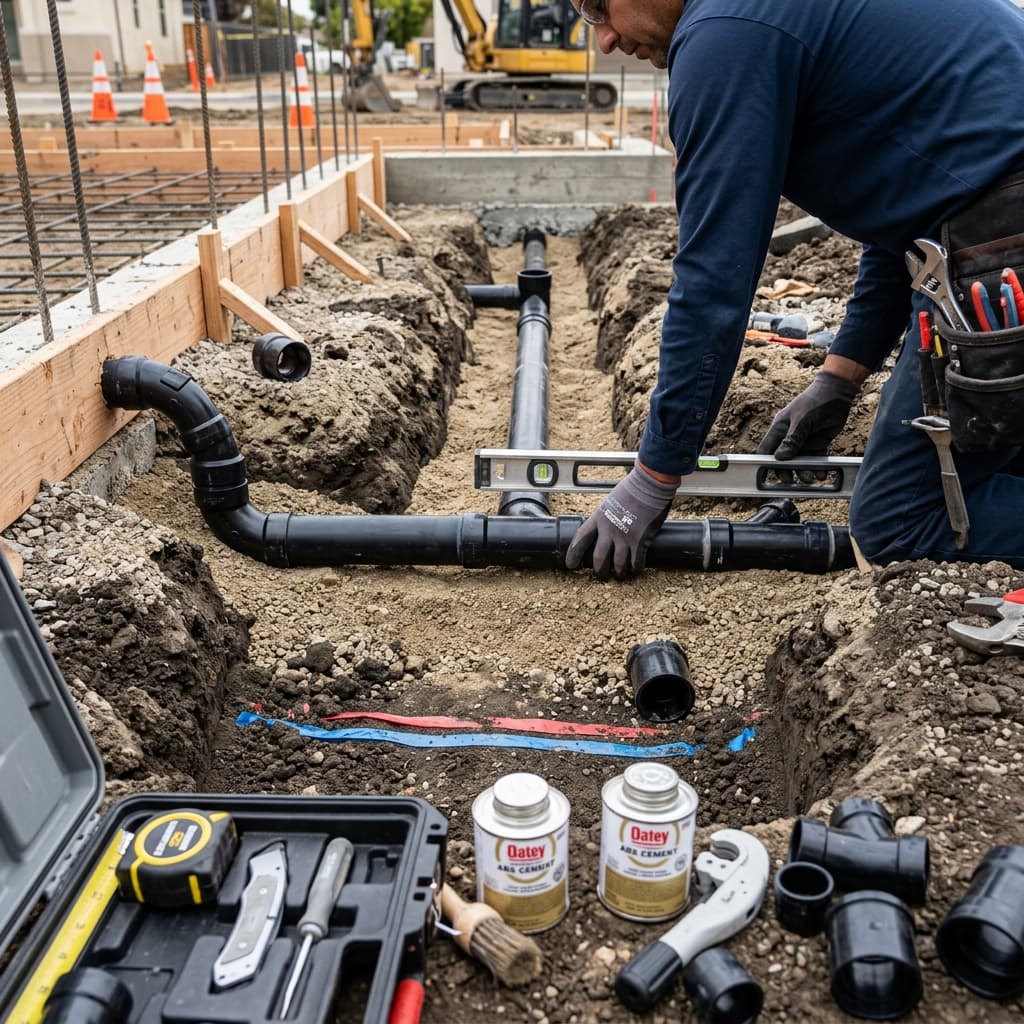
Proper bedding prevents pipe damage and settling, which causes improper slope and potential backups.
CPC Section 704.6 requires:
- Minimum 4 inches of sand or gravel beneath all underground pipes
- Support along the entire length of the pipe
- Compacted backfill in 12-inch lifts
- No rocks or debris that could puncture or damage pipe
Slope Calculations: A Critical Exam Area
Slope represents one of the most frequently tested aspects of CPC Section 702. Examiners present slope problems using different measurement formats to test comprehensive understanding.
Understanding Slope Notation
Slope can be expressed as:
- Rise over run ratio: 1/4 inch per foot means 1/4 inch of vertical drop for every 12 inches of horizontal distance
- Percentage: 1/4 inch per foot = 2.083% slope
- Degrees: Approximate 1/4 inch per foot = 1.19 degrees
Slope Calculation Example
Problem: A building sewer must travel 120 feet from the building drain to the public sewer. The starting invert elevation is 102 feet. If minimum slope of 1/4 inch per foot is required, what is the ending invert elevation? Solution:- Distance = 120 feet
- Slope = 1/4 inch per foot
- Total drop = 120 × 0.25 inches = 30 inches = 2.5 feet
- Ending invert = 102 - 2.5 = 99.5 feet
Maximum Slope Considerations
While CPC Section 702 emphasizes minimum slope, examiners also test maximum slope knowledge. Slopes exceeding 1/4 inch per foot can cause:
- Velocity too high: Water moves faster than solids, separating particles
- Pipe scour: High-velocity water erodes interior pipe surfaces
- Fixture seal deterioration: Excessive slope breaks trap seals
Common Exam Scenarios and Solutions
Scenario 1: Multi-Story Building with Different Zones
Question: A four-story office building has 120 fixture units on the upper three floors and 35 fixture units on the ground floor. The building has two separate building drains that converge. What size building sewer is required? Solution: According to CPC Section 702, add all fixture units: 120 + 35 = 155 FU. Reference the sizing table: 155 fixture units requires a 5-inch pipe with minimum 1/8-inch slope.This tests both consolidation knowledge and proper table interpretation.
Scenario 2: Existing System Expansion
Question: An existing commercial building has a 3-inch building sewer sized for 45 fixture units. The owner wants to add 20 fixture units. Is the existing 3-inch pipe adequate? Solution: New total = 45 + 20 = 65 FU. Per CPC Section 702 table, 65 fixture units requires a 4-inch pipe minimum. The existing 3-inch pipe is undersized. This would require system modification.Candidates must understand that oversizing is acceptable but undersizing violates code.
Scenario 3: Tricky Slope Problem
Question: A building sewer spans 200 feet. The starting point is at elevation 250 feet. If a 1/8-inch per foot slope is used, what is the approximate ending elevation? Solution:- Drop = 200 feet × 1/8 inch per foot = 25 inches = 2.083 feet
- Ending elevation = 250 - 2.083 = 247.917 feet (approximately 248 feet)
Materials Selection Under CPC Section 702
While Section 703 provides detailed material standards, Section 702 implementation requires understanding which materials are appropriate for different conditions.
PVC Pipe Considerations
- Most cost-effective for residential applications
- Requires proper slope and bedding (cannot bridge unsupported spans)
- Cannot be used where subject to damage from external loading
- Must meet ASTM D3034 (SDR 26) for gravity flow systems
Clay Pipe Advantages
- Excellent durability (50+ years)
- Superior for corrosive soil conditions
- More expensive than PVC
- Requires careful joint sealing per CPC Section 704.5
Cast Iron Pipe Applications
- Preferred where external loads are heavy
- Used in industrial applications
- More expensive than PVC or clay
- Susceptible to corrosion in certain soil environments
Inspection and Cleanout Requirements
CPC Section 702 and 704 address cleanout placement critical for California plumbing code drainage systems maintenance.
Building sewers require:
- Cleanouts at changes in direction (exceeding 45 degrees)
- Cleanouts at junction points where building drains converge
- Accessible cleanouts at the building exterior (typically within 3-5 feet of building)
- Minimum 4-inch diameter for cleanout pipes (some areas require larger)
Study Tips for CPC Section 702 Exam Success
Essential Knowledge for Test Day
- Memorize the fixture unit table from Section 422—this is non-negotiable
- Know the sizing table by heart or understand how to rapidly reference it
- Practice slope calculations in multiple formats until conversions are automatic
- Understand the "why" behind requirements—not just the "what"
- Review Section 703 and 704 for material and installation context
Practice Exam Strategies
- Work through calculations without a calculator first to build mental math proficiency
- Create flashcards comparing building sewer vs. building drain requirements
- Draw slope diagrams to visualize elevation changes
- Study real inspection reports identifying common code violations
Common Knowledge Gaps
Candidates often struggle with:
- Distinguishing between 1/4" and 1/8" slope applications
- Converting inches to feet in slope calculations
- Understanding simultaneous use factors (when applicable)
- Recognizing when fixtures require special drainage considerations
Conclusion
CPC Section 702 represents foundational knowledge for California plumbing code drainage system design. Mastery of building sewer sizing, fixture unit calculations, and installation requirements directly translates to success on the C-36 Part 5 examination.
Focus your preparation on understanding not just the code requirements but the engineering principles underlying them. When you understand why minimum slope prevents solids separation or why proper bedding prevents settling, exam questions become straightforward applications of logical principles rather than memorized facts.
The investment in thorough Section 702 understanding pays dividends throughout your entire examination because drainage system principles integrate into multiple exam sections. Master this material, and you're well-prepared for successful licensure.