
# Permit Requirements and Plan Review Standards for California C-36 Contractors
The foundation of professional plumbing practice in California rests on understanding plumbing permit requirements CPC and the rigorous plan review standards that protect public health and safety. For C-36 plumbing contractors, mastering these administrative requirements isn't just about regulatory compliance—it's essential for passing the California contractor license exam and operating a legitimate plumbing business.Understanding C-36 Licensing and Its Connection to Permits
What is a C-36 License?
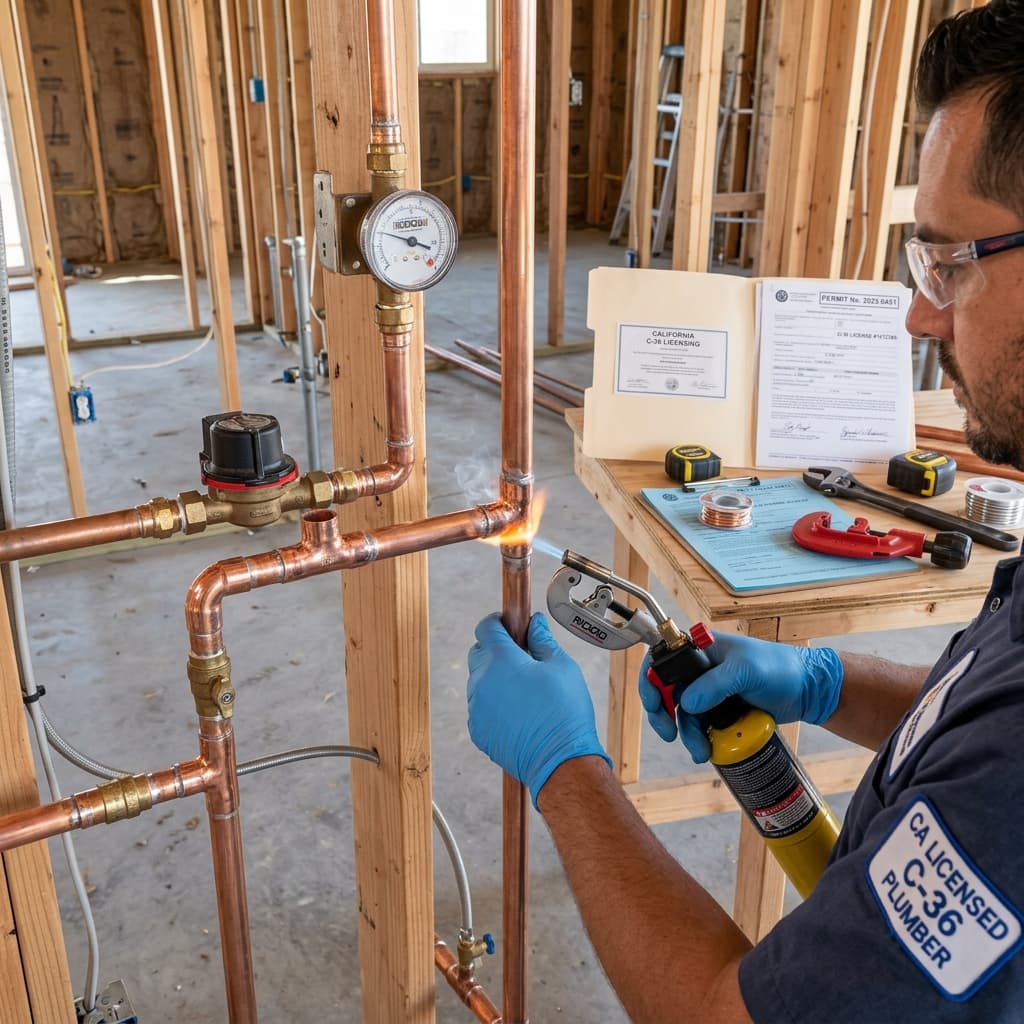
The C-36 classification represents a specialty contractor license specifically for plumbing work in California. According to the California Code of Regulations (CCR), a C-36 licensee is authorized to install, alter, repair, and maintain all plumbing systems and equipment. However, this authority only extends to work that complies with local ordinances and holds appropriate permits.
Critical exam insight: The C-36 plumbing license requirements california standards establish that licensing and permitting are inseparable. You cannot legally perform plumbing work without both a valid C-36 license AND a permit for the specific project.The Regulatory Framework
California's plumbing regulations operate under several key regulatory documents:
- California Plumbing Code (CPC) - The state's adopted model code
- Title 24 - California Building Standards Code
- Local Municipal Codes - County and city-specific amendments
- California Code of Regulations (CCR) Division 20 - Contractor licensing requirements
Permit Requirements Under CPC Standards
Types of Permits Required
Under CPC Section 308.1, property owners and contractors must obtain permits for:
Major Work Requiring Permits:- Water supply system installations and alterations
- Drainage and waste system installations
- Vent system modifications
- Gas piping installations (when applicable to plumbing systems)
- Backflow prevention device installations
- Greywater system installations
- On-site wastewater treatment systems
- Minor repairs and replacements of existing fixtures
- Maintenance work
- Removal of fixtures (some jurisdictions)
- Replacement with identical materials
The Permit Application Process
CPC Section 308.2 through 308.5 outlines the permit approval sequence:
- Applicant Qualifications - The permit applicant must be the property owner, an authorized agent, or a licensed contractor
- Completed Application - Forms must include property identification, scope of work, and contractor information
- Plan Submission - For most installations, approved plans must accompany the application
- Fees - Non-refundable permit fees based on project valuation
- Issuance - AHJ (Authority Having Jurisdiction) approval and permit issuance
- Posting - Permit must be displayed at the work site
Contractor Responsibility in Permitting
As a C-36 contractor, you bear specific responsibilities outlined in CPC Section 305 and Business & Professions Code Section 7028:
- Verification of permits before commencing work
- Accuracy of permit applications regarding scope and materials
- Site safety ensuring permits are posted and visible
- Compliance documentation maintaining records of inspections
- Change order procedures for work scope modifications requiring new permits
Plan Review Standards for California Plumbing
Purpose of Plan Review
Plan review under CPC Chapters 3 and 4 serves multiple critical functions:
- Ensures proposed work complies with code requirements
- Identifies potential conflicts with existing systems
- Verifies designer qualifications
- Confirms material specifications meet standards
- Protects public health and safety
What Plans Must Include
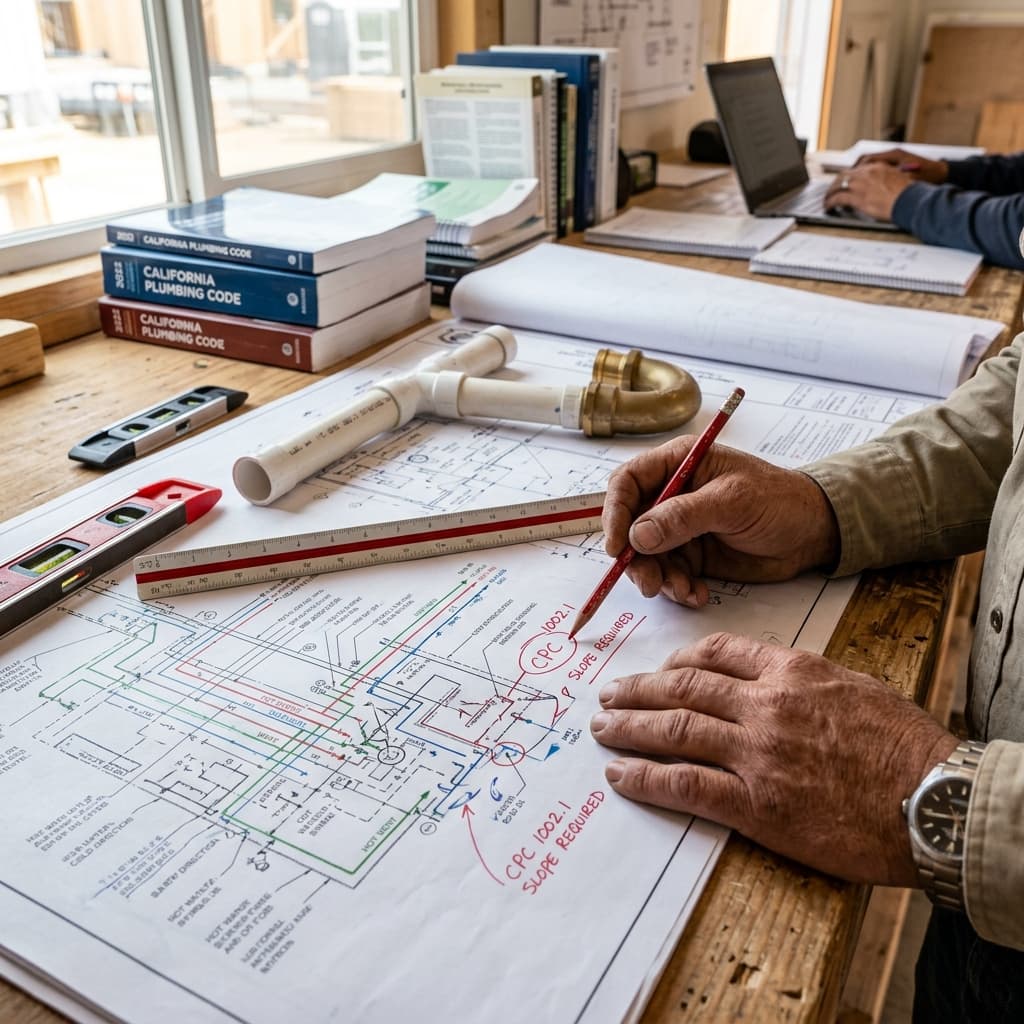
CPC Section 303 specifies minimum plan requirements:
Required Plan Components:- Property location and legal description
- Existing plumbing systems affected by the work
- New system design with material specifications
- Fixture counts and water pressure requirements
- Drainage system slope calculations
- Vent system sizing and arrangement
- Backflow prevention specifications
- Connection points to public sewer or septic systems
- Registered architect
- Licensed professional engineer
- Qualified designer with specific training
The Formal Review Process
AHJ plan reviewers examine submissions against CPC standards following this sequence:
First Review Phase:- Completeness check
- Code compliance evaluation
- Material specification verification
- AHJ identifies discrepancies
- Designer resubmits revised plans
- Cycle repeats until approval
- Plan examiner stamps "Approved" or "Approved as Noted"
- Contractor receives approved set
- Work may commence upon permit issuance
Contractor Licensing Requirements in the Permit Process
Verification of Contractor Status
Before issuing permits, AHJs must verify contractor licensing through CSLB (Contractors State License Board) records. CPC Section 305.5 mandates:
- Valid C-36 license status (not expired, suspended, or revoked)
- Current workers' compensation insurance
- Current bonding requirements ($2,500 minimum for C-36)
- No outstanding violations or disciplinary actions
Responsible Managing Employee (RME)
The RME must be continuously employed by the contracting entity and:- Hold a valid C-36 license
- Maintain active involvement in plumbing operations
- Be authorized to make licensing and permit decisions
Insurance and Bonding in Permitting
CPC Section 305.3 and B&PC Section 7071 require contractors maintain:
| Requirement | Amount | Requirement | Amount | |-----------|--------|-----------|--------| | Performance Bond | $2,500-$25,000 | Workers' Comp | Statutory | | License Bond | $5,000 | General Liability | Varies by project |
These must remain current throughout permit validity and project completion.
Plan Review Standards Specific to Common C-36 Systems
Water Supply Systems
Plan review for water supply installations (CPC Chapter 6) examines:
- Material specifications - Copper, PVC, PEX, or approved alternatives
- Sizing calculations - Based on fixture units and demand (CPC Table 422.1)
- Pressure regulation - Requirements for pressures exceeding 80 psi
- Backflow prevention - Device type matching hazard level (CPC Section 608)
Drainage Systems
Plan reviewers verify drainage designs per CPC Chapter 7:
- Slope requirements - Minimum 1/4" per foot for most drains (CPC Table 703.2)
- Pipe sizing - Based on drainage fixture units (CPC Table 703.2)
- Trap requirements - Every fixture requires appropriate trap per CPC Section 702
- Cleanout placement - Accessibility and spacing requirements (CPC Section 706)
Vent Systems
Vent system plan review ensures compliance with CPC Chapter 8:
- Vent sizing - Determined by drain line diameter and length (CPC Table 802.2)
- Stack requirements - Proper sizing and materials
- Termination - Minimum heights above roof (CPC Section 802.1)
- Relief vent provisions - For long horizontal runs exceeding code limits
Backflow Prevention Devices
CPC Section 608 plan review requirements include:
- Hazard assessment - Identifying cross-connection risks
- Device selection - Atmospheric vacuum breaker vs. reduced pressure principle device
- Installation location - Accessibility for testing and maintenance
- Testing protocols - Annual certification requirements
Common Permit and Plan Review Issues
Reasons for Plan Rejection
AHJs commonly return plans for corrections due to:
- Incomplete information - Missing fixture counts, pipe sizes, or material specs
- Code violations - Inadequate vent sizing, improper slopes, oversized traps
- Conflicting installations - Incompatible with existing systems
- Designer qualifications - Unsigned by qualified professional
- Hazardous conditions - Improper backflow protection or cross-connections
Amendments After Permit Issuance
Changes discovered during construction require:
- Minor modifications - AHJ approval without formal plan amendment
- Significant changes - New permit or change order may be required
- Scope expansion - Complete permit resubmission
- Cost increases - May require additional permit fees
Enforcement and Compliance
Inspection Requirements
CPC Section 109 mandates inspections at specified stages:
- Rough inspection - Before concealment of pipes and connections
- Final inspection - After system completion and pressure testing
- Special inspections - For complex systems like solar thermal or greywater
Certificate of Compliance
Upon passing final inspection, the AHJ issues a Certificate of Compliance acknowledging:- Code-compliant installation
- Successful pressure and performance testing
- Contractor accountability for quality
- Occupancy authorization for the system
Violations and Corrections
Non-compliance issues result in:
- Stop work orders - Preventing further work until violations corrected
- Notice of violation - Specifying required corrections and deadlines
- Correction permits - Sometimes required for code violation fixes
- License discipline - CSLB enforcement action against contractor
Practical Exam Scenarios and Answer Strategies
Scenario 1: Missing Plan Elements
Question: A C-36 contractor submits a water supply plan lacking pipe sizing calculations. The AHJ will most likely: A) Issue the permit with notation B) Request revised plans with sizing per CPC Table 422.1 C) Allow work to proceed with engineer supervision D) Issue a violation notice Correct Answer: B - Plan review standards require complete specifications before approval.Scenario 2: Permit Responsibility
Question: A homeowner hires a C-36 contractor for bathroom remodel including new drain lines. The contractor's responsibility includes: A) Ensuring AHJ verification of homeowner ownership B) Obtaining the permit and ensuring work compliance with plans C) Supervising inspector approvals throughout construction D) Certifying plan compliance on behalf of the designer Correct Answer: B - Contractors must ensure permits exist and work matches approved plans.Scenario 3: Plan Review Timing
Question: Under CPC Section 308, the AHJ has how many days to issue or reject a permit application? A) 5 business days B) 10 calendar days C) 15 business days D) 30 calendar days Correct Answer: C - CPC 308.4 specifies 15 calendar days for plan review and issuance/rejection.Study Tips for Part 2 Exam Success
- Master CPC Section 303-310 - These sections appear frequently in Part 2 questions
- Review local amendments - Many questions reference jurisdiction-specific modifications
- Practice permit scenarios - Work through real permit applications and review processes
- Study contractor responsibilities - Understand the C-36 contractor's role in permitting
- Memorize plan review standards - Know what elements reviewers examine for each system type
- Understand enforcement procedures - Know inspection timing, violations, and corrections
Conclusion
The intersection of plan review standards california plumbing and contractor license exam california preparation demands thorough understanding of permit processes, plan requirements, and contractor obligations. These administrative requirements, covered extensively in Part 2 of the C-36 exam, form the legal and safety framework protecting California's plumbing infrastructure.By mastering permit requirements, plan review standards, and your licensing obligations, you'll not only pass the exam but also build a compliant, professional plumbing practice that protects clients and maintains public trust. The AHJ and plan reviewers are your partners in ensuring quality work—understanding their perspective strengthens your entire operation.
---
Next: Explore our guide to inspection procedures and final approvals