
# Mastering CPC Section 422 Fixture Units: Shower and Bathtub Requirements for California C-36 Exam Success
When preparing for the California C-36 plumbing contractor's examination, understanding CPC Section 422 fixture units for showers and bathtubs is fundamental to Part 2: Water Supply and Distribution. These fixture unit calculations form the backbone of proper water supply system design and are among the most tested concepts on the exam.What Are Fixture Units and Why Do They Matter?
Fixture units are standardized measurements used in the California Plumbing Code to calculate water demand and sizing requirements for plumbing systems. They represent the probable maximum simultaneous use of fixtures in a building.
CPC Section 422 specifically addresses fixture unit values for various plumbing fixtures, and understanding these requirements determines:- Water supply line sizing
- Water meter capacity requirements
- Pressure regulator sizing
- System demand calculations
- Building water service line diameter
CPC Section 422: Fixture Unit Requirements Overview
The California Plumbing Code Section 422 establishes fixture unit values that must be used when calculating total water demand for any plumbing system. These values are not arbitrary—they're based on actual fixture flow rates and statistical usage patterns.
Key principle: Fixture units account for the fact that not all fixtures will be used simultaneously. A residential home with 10 fixtures won't have all 10 running at the exact same moment. The fixture unit table in CPC Section 422 provides different values depending on:- Whether the fixture serves residential or commercial use
- The type of supply valve (gravity or pressure)
- Local water pressure conditions
Shower Fixture Unit Requirements (CPC Section 422)
Standard Shower Stalls and Spray Showers
Under CPC Section 422, a standard shower stall or spray shower fixture is assigned 1 fixture unit. This applies to:- Individual shower stalls in residential bathrooms
- Combination tub-shower units (when used as shower only)
- Commercial shower stalls
- Spray shower fixtures
Multiple Shower Installations
When calculating fixture units for multiple showers in a building:
- Count each shower stall or spray fixture as 1 fixture unit
- Do not assume all showers will run simultaneously
- Apply the demand factor from the fixture unit demand table for your building type
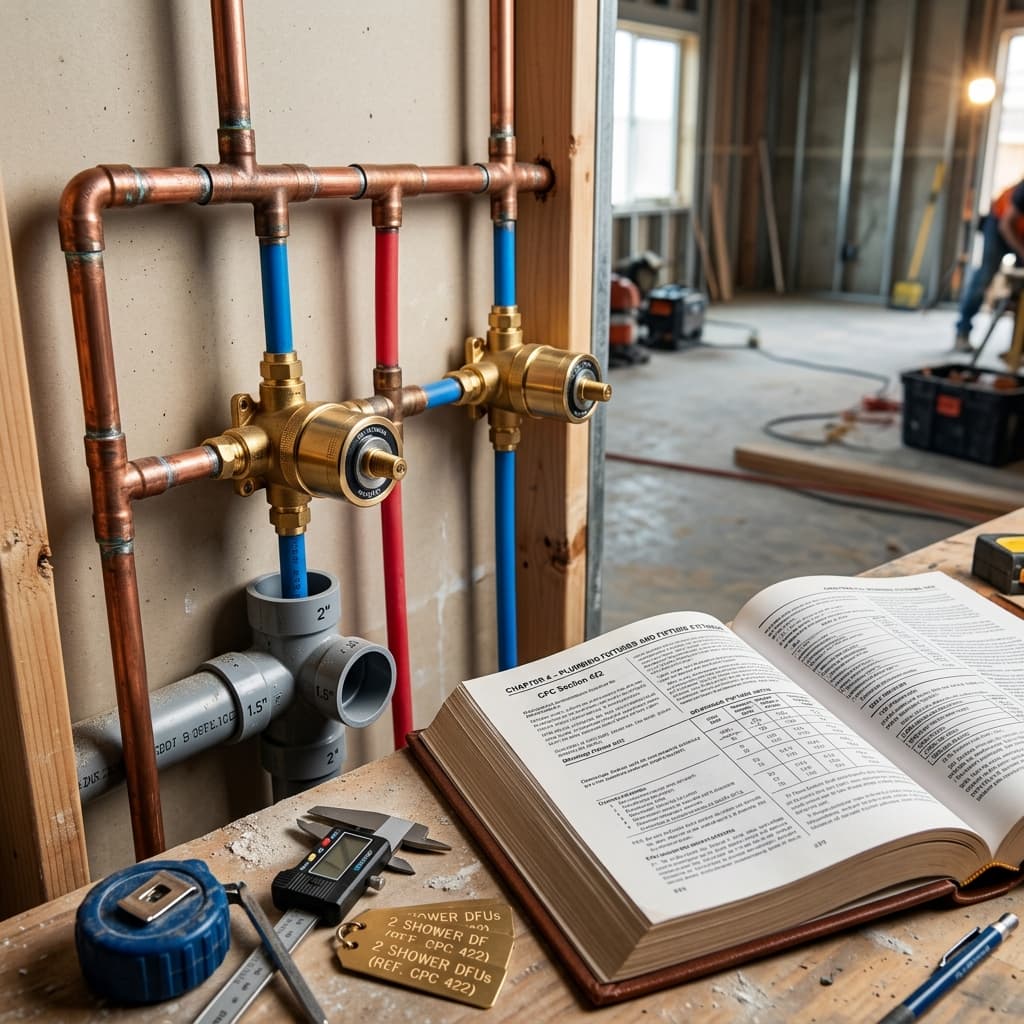
- Shower 1: 1 fixture unit
- Shower 2: 1 fixture unit
- Total: 2 fixture units (before demand factor reduction)
Thermostatic Mixing Valves and Shower Requirements
CPC Section 422 and related sections require thermostatic or pressure-balancing mixing valves on shower and bathtub installations to prevent scalding. While these requirements don't change the fixture unit value, they do impact:
- Supply line routing
- Hot water sizing
- Temperature control calculations
Bathtub Fixture Unit Requirements (CPC Section 422)
Standard Bathtubs
A standard bathtub is assigned 1.5 fixture units under CPC Section 422. This higher value than showers reflects:- Longer filling time requirements
- Higher water volume needs
- Larger diameter supply connections typical of tub installations
Combination Tub-Shower Units
When a fixture combines both bathtub and shower functionality:
- Calculate as a bathtub (1.5 fixture units) if used primarily for bathing
- The shower spray serves as an auxiliary feature
- Some jurisdictions may allow you to use 1 fixture unit if documentation shows shower-only use
- Always defer to your local authority having jurisdiction (AHJ)
Whirlpool Tubs and Soaking Tubs
CPC Section 422 fixture unit assignments:- Standard whirlpool tub: 1.5 fixture units (same as conventional bathtub)
- Soaking tub: 1.5 fixture units
- Supply connections for recirculation pumps
- Separate cold and hot water lines
- Drain and overflow sizing
Half-Baths and Fixtures without Tubs
For bathroom fixtures that include shower but no bathtub:- Shower stall only: 1 fixture unit
- Lavatory (sink): 0.5 fixture units
- Water closet (toilet): 0.75-1.0 fixture units (depending on tank vs. valve)
- Total: approximately 2.25-2.5 fixture units for a complete half-bath
Understanding the Fixture Unit Demand Table
CPC Section 422 includes demand tables that reduce total fixture units based on building type and number of fixtures. This is crucial for exam success.
Residential Demand Factors
In residential buildings, demand factors recognize that households don't use all fixtures simultaneously:
- 1-2 fixture units: 100% demand factor (no reduction)
- 3-5 fixture units: 70-80% demand factor
- 6-10 fixture units: 60-70% demand factor
- 11+ fixture units: 50-60% demand factor
Commercial Demand Factors
Commercial buildings typically use higher demand factors because multiple occupants increase simultaneous fixture use:
- Hotels and motels: 40-50% demand factor
- Apartment buildings: 50-60% demand factor
- Office buildings: 40-50% demand factor
Water Supply Line Sizing Using Fixture Units
Once you've calculated total fixture units using CPC Section 422 requirements, the next step involves sizing water supply lines.
The process:- Calculate total fixture units (showers, tubs, and other fixtures)
- Apply appropriate demand factor from CPC Section 422 Table 422.1
- Convert fixture units to gallons per minute (gpm) using Table 422.1
- Reference CPC Table 604.7 to determine required water line diameter
Example Calculation
Two-story residential home with:- 3 shower stalls: 3 × 1 = 3 fixture units
- 2 bathtubs: 2 × 1.5 = 3 fixture units
- 3 lavatories: 3 × 0.5 = 1.5 fixture units
- 2 water closets: 2 × 0.75 = 1.5 fixture units
- Kitchen sink: 1 fixture unit
- Outdoor hose bibs: 2 × 0.5 = 1 fixture unit
- Adjusted demand: 11 × 0.55 = 6.05 fixture units
- Gallons per minute: approximately 12-15 gpm
- Minimum line diameter: typically 3/4" or 1" (consult CPC Table 604.7)
Common C-36 Exam Questions About Fixture Units
Understanding how fixture units are tested helps you prepare effectively:
Question type 1: Direct recall "What is the fixture unit value for a standard shower stall?" Answer: 1 fixture unit per CPC Section 422 Question type 2: Calculation-based "A residential building has 4 showers and 3 bathtubs. What is the total fixture unit demand (before applying demand factor)?" Answer: (4 × 1) + (3 × 1.5) = 8.5 fixture units Question type 3: Application-based "A hotel with 250 guest rooms needs to be sized. How would you calculate fixture units differently than a residential home?" Answer: Apply commercial demand factor rather than residential; expect 60-80% simultaneous use rather than 50-60% Question type 4: Code compliance "Which CPC section specifies fixture unit values for showers and bathtubs?" Answer: CPC Section 422Bathroom Fixture Layout and Unit Calculations
When designing bathroom plumbing systems for the exam, remember:
- Each fixture requires its own fixture unit calculation
- Multiple fixtures in one bathroom don't get special "grouping" reduction
- Calculate individual fixture units first, then apply building-wide demand factor
- Always include all fixtures: toilets, bidets, urinals, sinks, showers, and tubs
- Shower stall: 1 FU
- Bathtub: 1.5 FU
- Two lavatories: 2 × 0.5 = 1 FU
- One water closet: 0.75 FU
- Subtotal: 4.25 FU
Key CPC Code References for Exam Preparation
Essential sections to review:- CPC Section 422: Fixture unit values and demand factors
- CPC Section 422.1: Table establishing fixture unit requirements
- CPC Section 604.7: Water supply line sizing based on demand
- CPC Section 424: Water distribution system design requirements
- CPC Section 608: Bathing facilities and shower requirements
Practical Tips for C-36 Exam Success
- Memorize key fixture unit values: Shower = 1 FU, Bathtub = 1.5 FU
- Understand demand factors: Know how they vary by building type
- Practice conversions: Become comfortable converting fixture units to gpm
- Review Table 422.1: This table appears frequently on exams
- Study demand tables thoroughly: They're essential for proper sizing calculations
- Use CPC Section references: Always cite the exact code section when answering
- Work through practice problems: Calculate multiple scenarios before exam day
Common Mistakes to Avoid
- Mistake 1: Confusing bathtub (1.5 FU) with shower (1 FU) values
- Mistake 2: Forgetting to apply demand factor to total fixture units
- Mistake 3: Not distinguishing between residential and commercial demand factors
- Mistake 4: Omitting fixtures from calculations (especially half-baths)
- Mistake 5: Using outdated fixture unit values from previous code editions
Moving Forward: Related Fixture Unit Topics
As you master CPC Section 422 shower and bathtub requirements, you'll also need to understand:
- Water supply line sizing and CPC Section 604
- Water meter selection based on fixture units
- Drainage system sizing using fixture units
- Pressure regulator requirements for fixture units
Summary: CPC Section 422 Fixture Unit Requirements
Mastering CPC Section 422 fixture unit requirements for showers and bathtubs is essential for C-36 exam success. Remember:- Standard showers = 1 fixture unit
- Standard bathtubs = 1.5 fixture units
- Apply appropriate demand factors based on building type
- Use fixture unit calculations to size water supply lines
- Always reference CPC Table 422.1 for calculations
- Understand the difference between residential and commercial demand factors
---META_EMPHASIS--- The California Plumbing Code Section 422 fixture unit values for showers and bathtubs form the mathematical foundation of water supply system design. Master these values, understand demand factors, and practice calculation problems relentlessly to ensure C-36 exam success.