# Kitchen and Bathroom Sink Drain Configuration: CPC Section 422 Trap and Vent Requirements for C-36 Exam
Mastering California Plumbing Code drainage requirements is essential for C-36 exam success. CPC Section 422 trap requirements form the foundation of proper sink drain configuration in both residential and commercial applications. Whether you're installing a simple kitchen sink or a complex bathroom lavatory setup, understanding Section 422 trap sizing, placement, and venting will directly impact your exam performance and field application.This comprehensive guide covers everything you need to know about CPC Section 422 regulations for kitchen and bathroom sink drains, with specific emphasis on the trap and vent requirements tested in Part 2 of the C-36 examination.
Understanding CPC Section 422: Trap Fundamentals
What is CPC Section 422?
CPC Section 422 establishes the fundamental requirements for traps in California plumbing systems. A trap is a U-shaped or S-shaped bend in the drainage line that maintains a water seal—typically 2 to 4 inches—to prevent sewer gases from entering the building through the drainage system.
CPC Section 422.1 states that every fixture shall be separately trapped by a seal that prevents the passage of gases without materially affecting the flow of wastewater. This is non-negotiable for every sink installation, whether it's a kitchen sink, bathroom lavatory, or wet bar. The trap performs two critical functions:- Sanitary protection - Maintains a water seal barrier against sewer gases, odors, and harmful bacteria
- Fixture protection - Isolates individual fixtures so a clog in one doesn't immediately affect others
Types of Traps Permitted Under California Code
The California Plumbing Code recognizes specific trap types for kitchen and bathroom sinks:
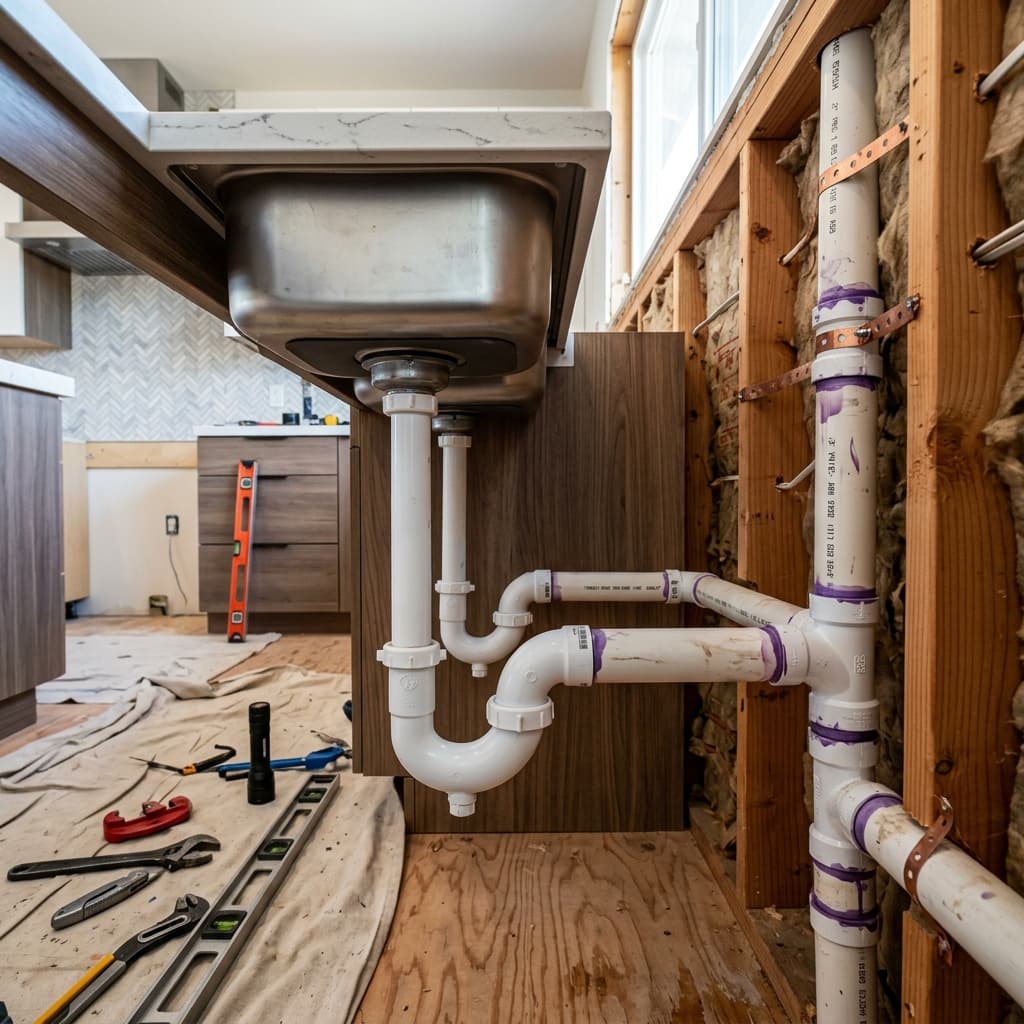
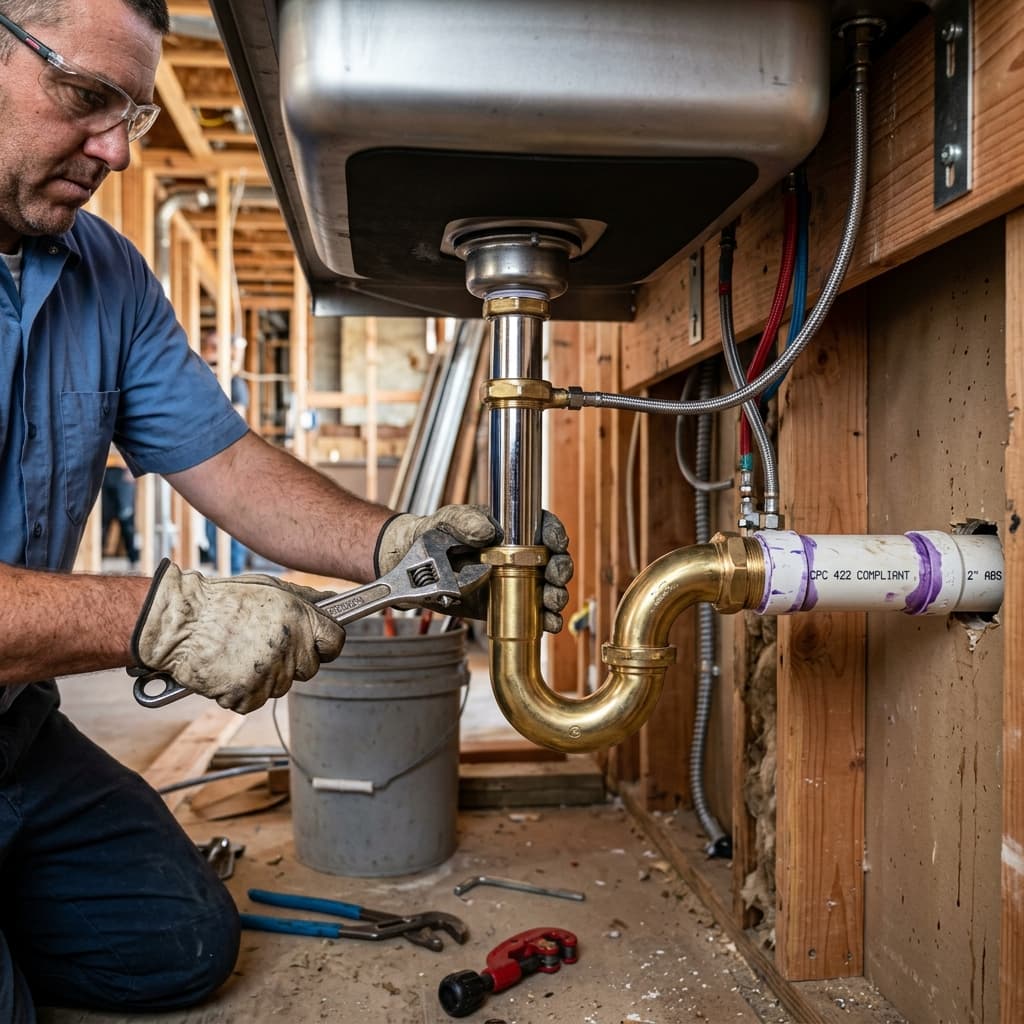
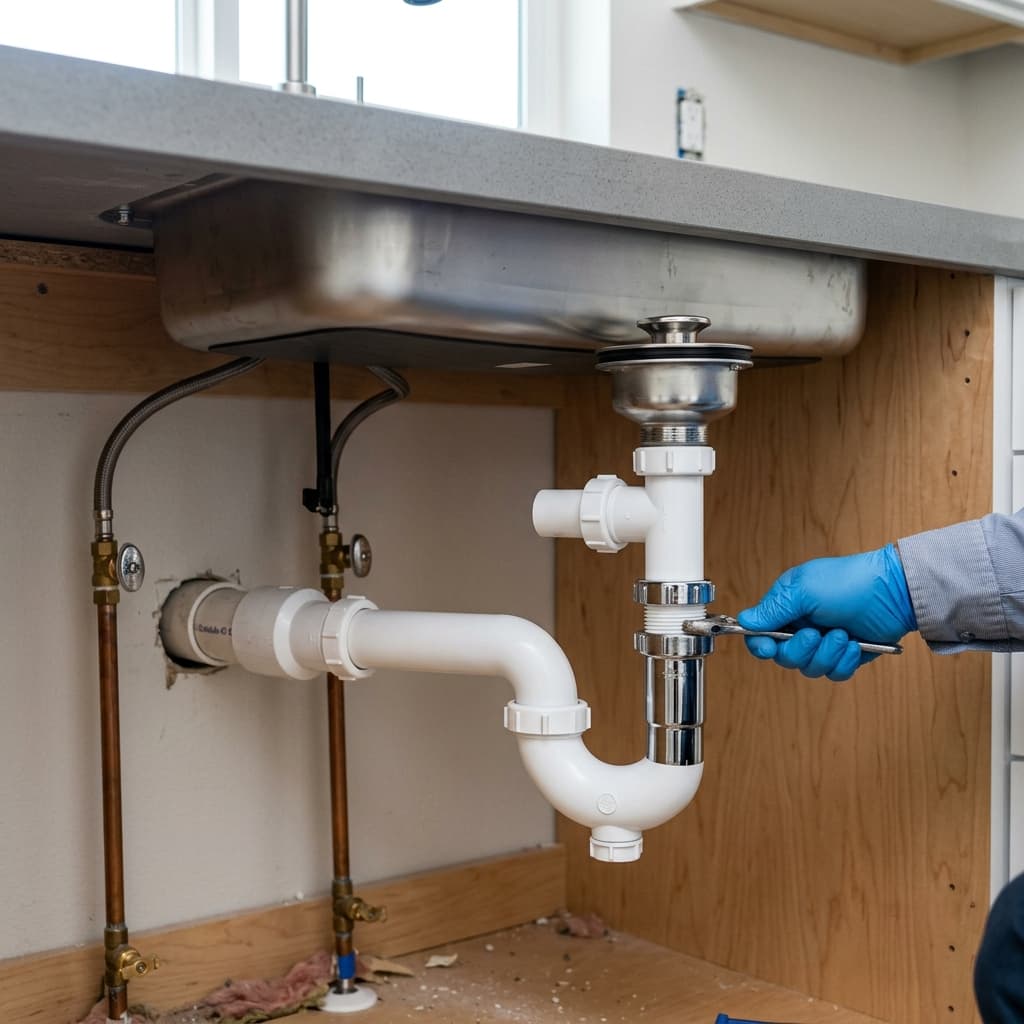
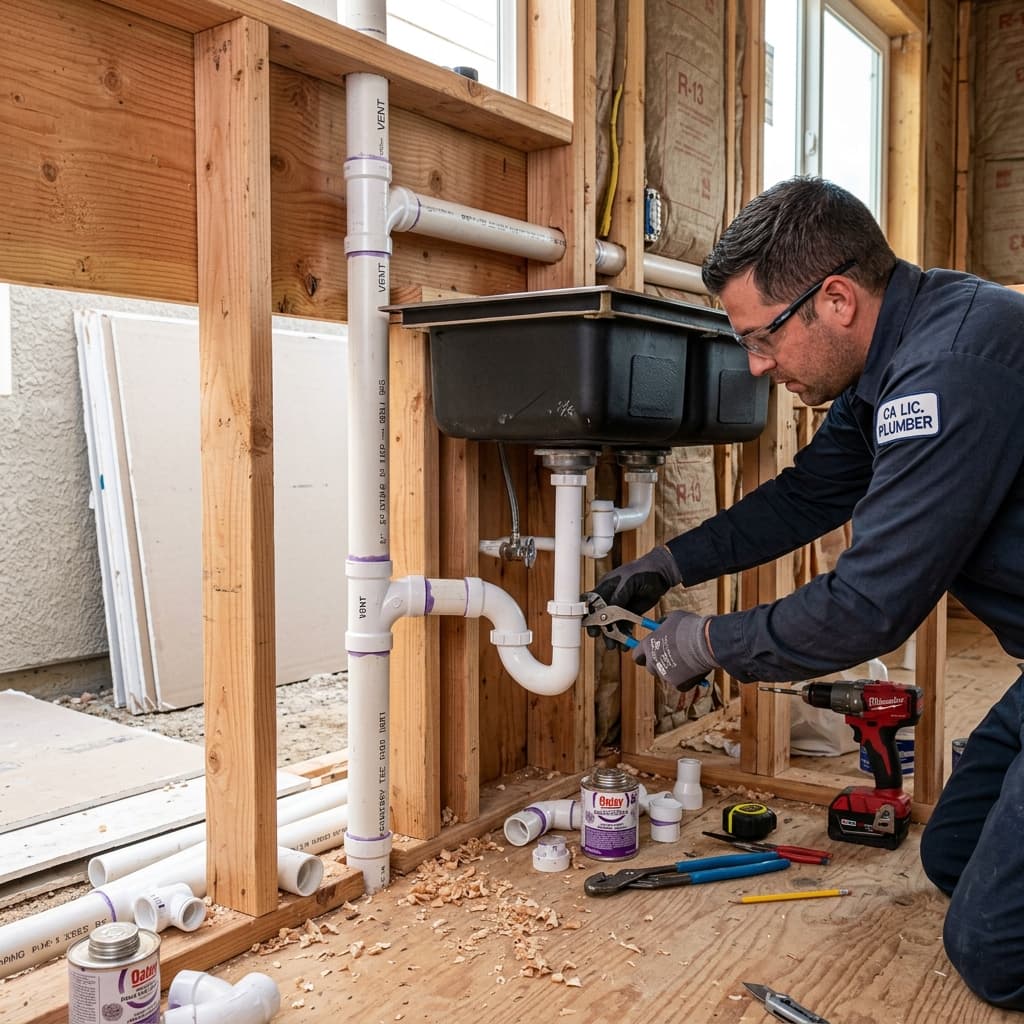
P-Traps are the most common trap configuration for sinks and are nearly always required. The "P" refers to the shape when viewed from the side, with the inlet at the top and outlet at the bottom. P-traps are highly effective and easy to maintain. S-Traps are curved traps that connect directly to the wall drainage line. While historically used, CPC Section 422.2 discourages S-traps in modern installations because they're prone to siphoning—where the water seal is broken by rapid drainage. Most C-36 exam scenarios involving residential kitchen and bathroom sinks will specify P-traps. Bottle Traps are compact, cylindrical traps often used in space-limited applications like pedestal sinks. They contain the trap seal within a bottle-shaped chamber and must meet the same seal and sizing requirements as P-traps.Sink Drain Configuration: Essential Components
Trap Sizing and Fixture Unit Calculations
Understanding plumbing fixture unit calculations is critical for proper drain sizing under California Plumbing Code requirements. A fixture unit (FU) is a measure of water discharge volume that helps determine pipe sizing. Kitchen sinks are typically assigned 1.5 fixture units under CPC Table 422.1. A double-bowl kitchen sink with a garbage disposal may require different sizing considerations, which we'll address below. Bathroom lavatories are assigned 1.0 fixture unit each. A bathroom with dual sinks (his and hers) would represent 2.0 combined fixture units for that drainage branch. Per CPC Section 703.2 and related drainage tables, the total fixture units served by any drainage line determine the required pipe diameter:- 1.5 FU or less = 1¼ inch minimum diameter pipe
- 2.0 FU = 1½ inch minimum diameter pipe
- 3.0 FU = 2 inch minimum diameter pipe
Trap Seal Depth Requirements
CPC Section 422 specifies exact water seal depth requirements:
- Standard sink traps: Maintain a minimum 2-inch seal and maximum 4-inch seal
- Bottle traps: Minimum 2-inch seal
- Floor drains and sumps: May require up to 3-inch seals
Critical Spacing and Clearance Requirements
Distance from sink to trap: The trap should be installed directly under or as close as practical to the sink outlet. This minimizes the untrapped drainage line and reduces the risk of siphoning. Maximum distance is typically 24 inches of vertical drop. Accessibility: CPC Section 422.1 requires that traps be readily accessible for cleaning and inspection. This means:- Trap arms must not be concealed in walls without access panels
- Cleanouts must be provided at the trap outlet or within the branch line
- Kitchen sink traps should never be installed where they cannot be easily reached for maintenance
Venting Requirements for Kitchen and Bathroom Sinks
Why Vents Are Essential to Drainage
Proper venting under California Plumbing Code is not optional—it's fundamental to drainage system function. Vents allow air to enter the drainage system, which:- Prevents trap seal loss through siphoning
- Allows wastewater to flow freely by equalizing pressure
- Prevents vacuum conditions that slow drainage
- Protects the trap seal integrity
Trap Arm Length and Vent Distance
One of the most frequently tested C-36 exam topics is the maximum distance between a trap and its vent. This is governed by CPC Section 308.4 in conjunction with fixture unit requirements: For a 1.5 FU kitchen sink:- Maximum trap arm length = 5 feet (measured from the trap outlet to the vent connection point)
- The trap arm must slope ¼ inch per foot toward the drain
- Maximum trap arm length = 5 feet
- Same slope requirement (¼ inch per foot minimum, ½ inch per foot is preferred)
- Air admittance valves (AAVs) - Mechanical one-way vents that allow air into the system but prevent sewer gas escape. Some jurisdictions restrict AAVs; always verify local amendments.
- Indirect waste piping - Sinks can drain to an interceptor or receiving fixture that has proper venting
- Vent relocation - Redesigning the system to bring the vent closer to the trap
Individual vs. Common Venting
Individual vents serve a single fixture and connect directly to the vent stack above the flood rim of any potential receiving fixtures. This is the standard approach for kitchen and bathroom sinks when practical. Common vents serve two or more fixtures at approximately the same elevation. For example, a powder room with a lavatory and a bidet could potentially share a common vent if properly sized and configured per CPC Section 308.2. When considering common venting for bathroom sink drains:- The branch interval on the common vent must be properly sized for total fixture units
- The vent connection point must be above the flood level of the highest fixture
- No fixtures can enter the common vent below the point where it becomes the common vent
Kitchen Sink Specific Considerations
Garbage Disposal Drainage Requirements
Kitchen sinks equipped with garbage disposals require special attention under California code:
Trap sizing - A garbage disposal doesn't change the trap size calculation. A single bowl kitchen sink is still 1.5 FU, requiring a 1¼ inch trap minimum. However, some jurisdictions recommend 1½ inch P-traps for garbage disposal applications to reduce clogging risk. Air gap requirement - If your kitchen sink has a dishwasher connection, CPC Section 807.1 requires an air gap between the dishwasher drain hose and the sink drain. The hose must rise at least 32 inches above the rim of the sink before connecting to the trap arm or disposal unit. This prevents backflow from the sink into the dishwasher. Trap location - With a garbage disposal, ensure the trap is installed at or immediately below the sink rim to minimize untrapped line length.Bathroom Sink Drain Configuration Examples
Single Lavatory in a Half Bath
A typical half bath with one lavatory is straightforward:- Fixture units: 1.0 FU
- Trap requirement: 1¼ inch P-trap minimum with 2-4 inch seal
- Vent requirement: Individual vent within 5 feet of trap outlet, sloped ¼ inch per foot minimum
- Cleanout: Required at trap outlet or within branch line
- Accessibility: All components must be accessible for maintenance
Dual Lavatories in a Master Bath
Two lavatories on opposing walls require careful planning:
Option 1: Individual vents - Each lavatory has its own 1¼ inch trap, and each is individually vented within 5 feet to separate vent stacks or a common vent stack (if properly sized). Option 2: Common drainage with individual vents - The two traps drain into a common line, which then connects to a common vent. The combined 2.0 FU requires minimum 1½ inch drainage and vent piping. Option 3: Common drainage with common vent - Both lavatories share a common drain AND vent configuration. The common vent must be properly sized for 2.0 FU, and the connection point must be above the flood rim of both fixtures.Under CPC Section 308, Option 3 is valid but requires careful attention to slope, sizing, and height requirements.
Common Exam Questions on Section 422
Trap Seal Depth Question Type
Example: "A kitchen sink P-trap is installed with a 5-inch seal depth. Is this compliant with CPC Section 422?" Answer: No. Maximum seal depth is 4 inches. Excessive seal depth can cause siphoning and is difficult to maintain.Vent Distance Calculation
Example: "A 1.5 FU kitchen sink has its trap 8 feet from the vent connection. The trap arm slopes ¼ inch per foot. What is required?" Answer: The trap is out of compliance. Maximum distance for a 1.5 FU fixture is 5 feet per CPC Section 308.4. The installation must be redesigned using an air admittance valve, relocating the vent closer, or using an indirect waste connection.Fixture Unit Determination
Example: "A bathroom with two lavatories, one water closet, and one shower. What are the combined fixture units for the drains?" Answer: 1.0 + 1.0 + 3.0 + 2.0 = 7.0 FU total. (Water closets are 3.0 FU, showers are 2.0 FU per CPC Table 422.1)Installation Best Practices for C-36 Compliance
Material Selection
California Plumbing Code permits several materials for trap and drain piping:- Cast iron - Traditional, durable, excellent sound attenuation
- PVC (DWV) - Lightweight, corrosion-resistant, budget-friendly (common in residential)
- ABS - Similar to PVC with slightly different thermal properties
- Copper - Premium option, often used in high-end residential
- Galvanized steel - Acceptable but less common due to corrosion concerns
Slope Requirements
All drain lines must slope toward the drainage outlet:- Standard slope: ¼ inch drop per foot of horizontal run (minimum)
- Preferred slope: ½ inch per foot (reduces clogging risk)
- Maximum slope: 45 degrees (steeper slopes can cause solids separation and trap seal loss)
Cleanout Access
CPC Section 309 requires cleanouts at specific locations:- At the base of each stack (where vertical becomes horizontal)
- At changes in direction exceeding 45 degrees
- At the outlet of each trap
- For runs exceeding 50 feet, cleanouts every 50 feet
Preparing for C-36 Part 2: Drainage and Venting
Understanding CPC Section 422 trap requirements and California plumbing code drainage principles will significantly improve your Part 2 performance. Focus your study on:- Memorizing fixture unit assignments - Know that kitchen sinks = 1.5 FU, lavatories = 1.0 FU
- Trap seal specifications - 2-4 inch range for standard traps
- Vent distance calculations - 5 feet maximum for 1.5 FU and smaller fixtures
- Common configuration scenarios - Be able to identify compliant vs. non-compliant installations