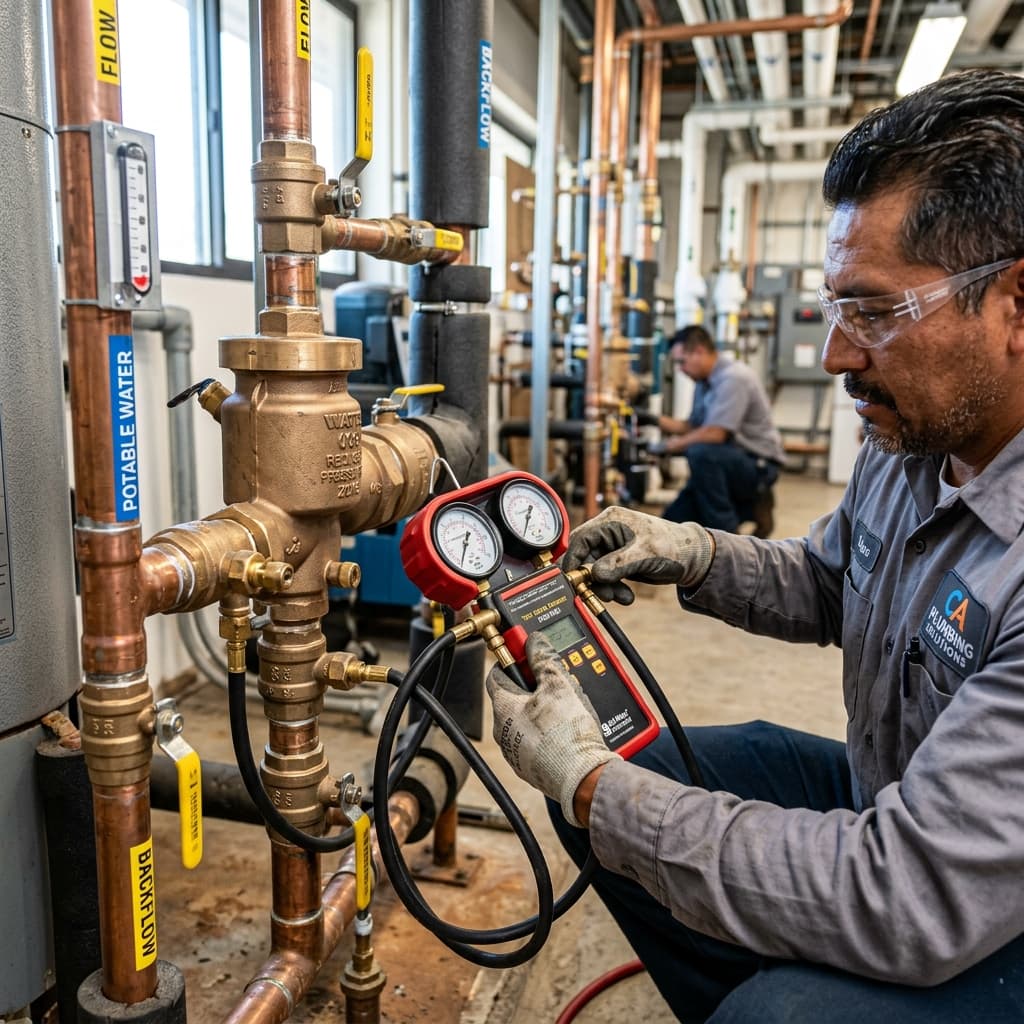

# CPC Section 422: Master Water Supply System Design for Your C-36 Exam
Water supply system design california requirements under CPC Section 422 form the backbone of Part 2 exam questions. Whether you're studying pressure regulation, backflow prevention, or sizing calculations, understanding these fundamentals is non-negotiable for C-36 success. This comprehensive guide breaks down the essential requirements you need to master.Understanding CPC Section 422 Framework
CPC Section 422 establishes the minimum requirements for water supply systems serving buildings and structures. This section doesn't stand alone—it works in conjunction with related sections to create a complete regulatory framework that governs how water enters your building, flows through pipes, and reaches fixtures.The primary purpose of Section 422 is to ensure:
- Adequate supply of potable water to all fixtures and appliances
- Proper pressure throughout the distribution system
- Protection against backflow and contamination
- Appropriate sizing based on actual demand
What Makes Section 422 Exam-Critical?
Examiners focus heavily on Section 422 because it requires analytical thinking beyond mere memorization. You need to:
- Calculate demand loads using fixture unit tables
- Apply pressure requirements to different scenarios
- Select appropriate backflow devices for specific applications
- Size supply lines correctly based on calculations
Pressure Regulation Requirements Under CPC Section 422
Pressure regulation separates professional plumbers from amateurs. The California Plumbing Code has specific requirements you must understand for exam success.
Supply Pressure Standards
CPC Section 422.1 requires that water pressure in the supply system shall be sufficient to supply the fixtures and devices at the pressures specified by their manufacturers. Generally:- Minimum pressure: 20 psi (pounds per square inch) at the lowest fixture
- Maximum pressure: 80 psi at any point in the system without a regulator
- Optimal operating range: 40-60 psi for most applications
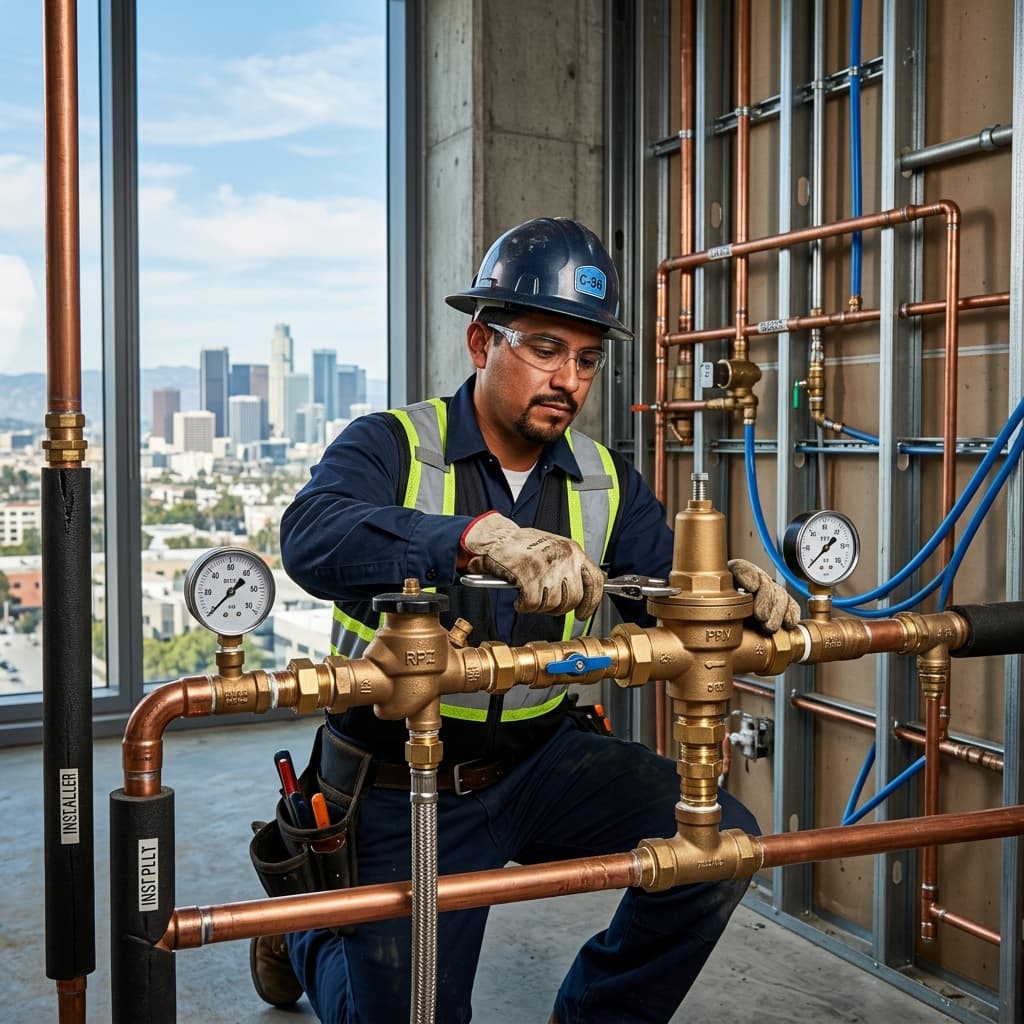
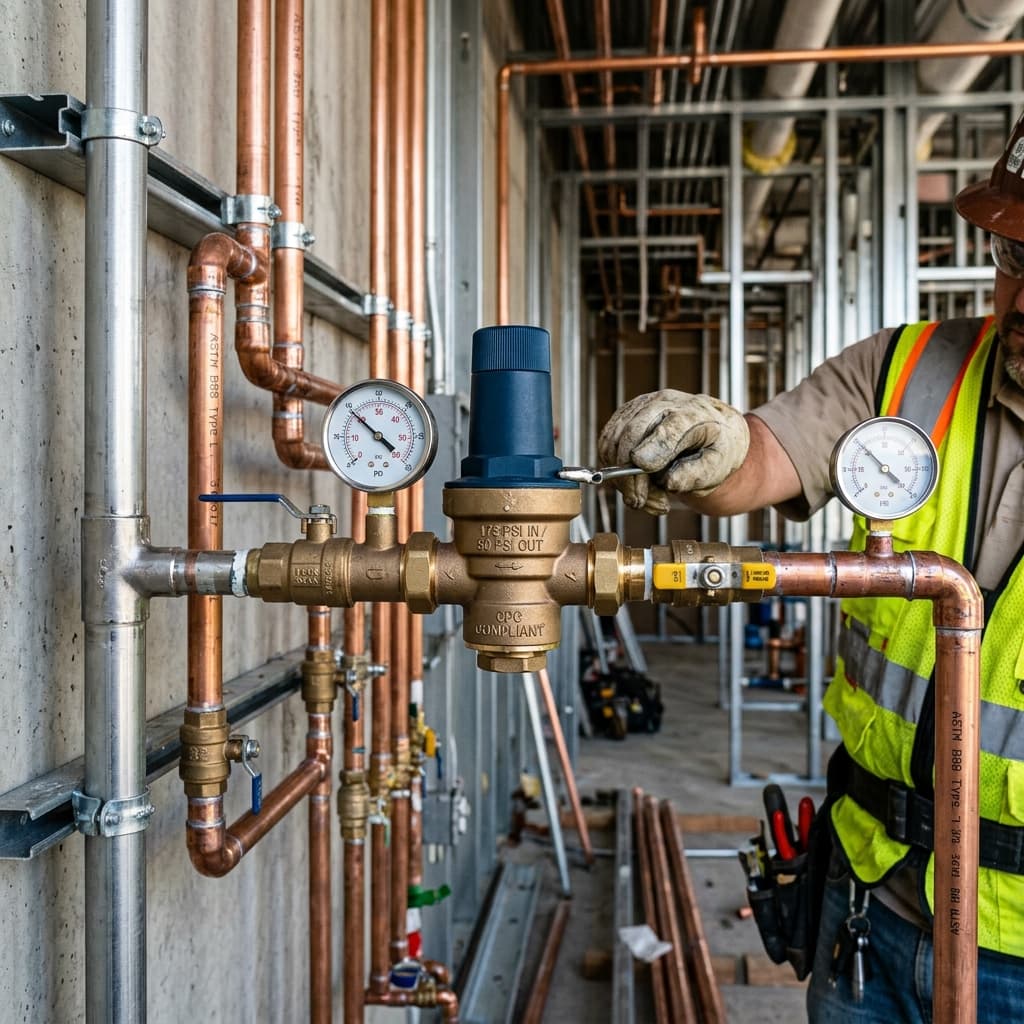
Pressure Reducing Valve (PRV) Selection and Installation
Understanding where and how to install pressure reducing valves is critical. Key exam points include:
Location Requirements:- Install immediately after the water meter or point of entry
- Before the main water shut-off valve in some jurisdictions
- Protect with a strainer on the inlet side
- Install a check valve downstream to prevent backpressure
- PRV outlet pressure should be set 10-15 psi below street pressure
- Valve outlet pressure must not exceed 80 psi
- Sized according to demand load (calculated in fixture units)
- Must include accessible adjustment screw for field adjustment
Pressure Tanks and Relief Valves
When boosting pressure with pumps, CPC Section 422.3 requires:- Pressure tank or air chamber for pump systems
- Pressure relief valve set to maximum 80 psi
- Check valve to prevent backflow to source
- Gauge and drain connections for maintenance
Backflow Prevention: A Major Exam Focus Area
Backflow prevention is arguably the most heavily tested aspect of Section 422. The California Plumbing Code takes water contamination extremely seriously.
Understanding Backflow and Cross-Connection Hazards
Backflow occurs when water flows in reverse direction, potentially carrying contaminated water into the clean supply. This happens through:- Backsiphonage: Reduction in supply pressure pulls contaminated water backward
- Backpressure: Higher pressure downstream pushes contaminated water upstream
Backflow Prevention Device Types and Applications
CPC Section 422.4 and related sections require specific device types for different hazard levels. Master these distinctions: #### Atmospheric Vacuum Breaker (AVB)- Hazard Level: Low (non-health hazard)
- Protection: Backsiphonage only
- Application: Outdoor hose bibbs, laboratory sinks with indirect drains
- Exam Point: Cannot protect against backpressure—a common wrong answer on exams
- Installation: Must be highest point in branch line; cannot be submerged
- Hazard Level: Low to moderate
- Protection: Both backsiphonage and backpressure up to 5 psi
- Application: Irrigation systems, ornamental fountains, spray heads
- Exam Point: Requires 6-inch clearance above highest outlet
- Testing: Requires annual testing per CPC Section 608.16.4
- Hazard Level: High (health hazard)
- Protection: Both backsiphonage and backpressure with redundancy
- Application: Laboratory drains, chemical injection lines, medical equipment
- Exam Point: Most stringent and expensive option—why use it? Answer: When health hazard exists
- Requirements: Two check valves with relief valve between; annual testing required
- Installation: Must drain and cannot be submerged; requires accessible test cocks
- Hazard Level: Low to moderate
- Protection: Backpressure and backsiphonage
- Application: Fire systems, irrigation with chemicals, industrial applications
- Exam Point: Similar to RPZ but lacks intermediate relief valve—cheaper but less protection
- Testing: Required per code; cannot be buried
When to Specify Each Device: Decision Matrix
Exam questions frequently present scenarios where you must select the correct device. Use this logic:
Health Hazard Present?- YES → Reduced Pressure Principle Device (RPZ)
- NO → Continue to next question
- YES → Need check valve protection or advanced device
- NO → Atmospheric vacuum breaker may suffice
- Medical/laboratory drains → RPZ
- Irrigation with chemicals → DCVA or RPZ
- Simple outdoor hose bibb → Atmospheric vacuum breaker
Water Supply Line Sizing: Calculations for Success
Water supply line sizing california requirements under CPC Section 422.5 demand that you master demand load calculations. This separates memorizers from practitioners.Understanding Demand Load Units
The California Plumbing Code uses supply fixture units (SFU) to calculate demand. This accounts for:- Fixture type and frequency of use
- Water pressure requirements
- Duration of typical use
| Fixture Type | Supply Fixture Units | |---|---| | Water closet (1.6 gpf) | 1.0 | | Bathroom sink | 0.75 | | Kitchen sink | 1.0 | | Shower | 1.0 | | Bathtub | 1.0 | | Hose bibb | 0.75 | | Washing machine | 1.0 |
Exam Strategy: You won't memorize all values—the exam provides tables. Focus on understanding the calculation process rather than memorizing each fixture unit value.Demand Load Calculation Process
Step 1: List all fixtures in the system being sized Step 2: Assign supply fixture units using CPC Table 422.1 Step 3: Total the SFU values for the entire system or branch Step 4: Apply demand factor using CPC Table 422.2The demand factor accounts for the statistical likelihood that all fixtures won't run simultaneously. A house with 10 fixtures doesn't need 10 times the pipe as a house with 1 fixture.
Example Calculation: A residential property has:- 2 bathrooms (2 toilets, 2 sinks, 2 showers): 2(1.0) + 2(0.75) + 2(1.0) = 5.5 SFU
- Kitchen sink: 1.0 SFU
- Laundry: 1.0 SFU
- Hose bibbs: 2(0.75) = 1.5 SFU
Pressure Drop and Pipe Sizing Table
Once you have demand in GPM, CPC Table 422.3 shows which pipe size carries that demand while maintaining acceptable pressure drop (typically 10-15 psi maximum per 100 feet of pipe). Key Exam Points:- Never oversize (wastes material and increases stagnation)
- Never undersize (causes low pressure complaints and code violations)
- Copper, PVC, and PEX have different friction loss characteristics
- Higher pressure systems tolerate larger pressure drops
- Longer runs require larger diameters
Integration with Other CPC Sections
Section 422 doesn't exist in isolation. Successful C-36 candidates understand how it connects:
CPC Section 608: Water Supply and Distribution
Details the physical requirements for water supply piping installation—diameter, materials, routing, support. Uses Section 422 demand calculations to determine what sizes to install.CPC Section 609: Water Distribution
Addresses specific distribution requirements including fixture outlet sizing, branch connections, and accessibility.CPC Section 610: Pressure Equipment
Covers pressure tanks, hydropneumatic systems, and pressure relief requirements that support Section 422 pressure regulation principles.Common Exam Question Patterns
Based on historical exam data, expect questions following these patterns:
Scenario-Based Questions: "A new residence will have 3 full bathrooms, kitchen, laundry, and 2 hose bibbs. Using CPC Section 422 tables, calculate the demand load and minimum main supply line size if street pressure is 75 psi." Code Requirement Questions: "Under CPC Section 422, what is the maximum water pressure allowed in a supply system without a pressure reducing valve?" Device Selection Questions: "A chemical fertilizer injection system for lawn irrigation requires which backflow prevention device per CPC Section 422.4?" Pressure Regulation Questions: "Where must a pressure reducing valve be installed per CPC Section 422?"Study Tips for Section 422 Success
Master the Tables
- Keep CPC Tables 422.1, 422.2, and 422.3 visible while practicing
- Do 10 demand load calculations until the process becomes automatic
- Practice with different pressure scenarios
Understand the "Why"
- Why do we use demand factors? (Not all fixtures run simultaneously)
- Why is backflow prevention critical? (Health and safety)
- Why do we limit pressure to 80 psi? (Fixture damage and burst risk)
Practice Application Problems
Create realistic scenarios:- "Size the water supply line for a commercial office with 20 fixtures"
- "Select backflow prevention for a hot tub fill line"
- "Design pressure regulation for a building with 110 psi street pressure"
Review Related Sections
Don't study Section 422 in isolation. Review CPC Section 608 water supply requirements and pressure equipment simultaneously.Final Exam Preparation Checklist
Before test day, verify you can:
- [ ] Calculate demand loads using fixture units and demand factors
- [ ] Select appropriate pipe sizes from pressure drop tables
- [ ] Identify when pressure reducing valves are required
- [ ] Specify correct backflow prevention device for any application
- [ ] Explain the difference between backsiphonage and backpressure protection
- [ ] Interpret CPC Table 422.1 (Supply Fixture Units)
- [ ] Apply CPC Table 422.2 (Demand Factors)
- [ ] Use CPC Table 422.3 (Pressure Drop and Sizing)
- [ ] Calculate outlet pressure for pressure reducing valves
- [ ] Understand pressure tank requirements for boosted systems
Conclusion
CPC Section 422 water supply system design requirements form the foundation of Part 2 exam success. By mastering pressure regulation principles, backflow prevention device selection, and demand load sizing calculations, you'll confidently answer the 15-20% of exam questions addressing these topics.The key to success isn't memorizing every detail—it's understanding the underlying logic. Pressure regulation protects fixtures. Backflow prevention protects health. Proper sizing ensures performance. When you understand the "why," you can answer any scenario question the examiner throws at you.
Start with the tables, practice realistic calculations, and integrate your Section 422 knowledge with related sections covering installation details. With focused study on these critical areas, you'll master Section 422 and significantly improve your overall C-36 exam performance.