Rewritten 25 September 2026. An earlier version of this article said Section 422 of the California Plumbing Code governs water supply line materials and sizing. It does not, and the subsection details it gave were wrong. This version was checked line by line against the 2025 California Plumbing Code as published by IAPMO.
If you searched for "CPC Section 422 water supply," you are not alone, and you have been pointed in the wrong direction. Section 422 is about how many toilets, lavatories and drinking fountains a building needs. Everything about the pipe that carries the water lives in Chapter 6. Here is what each one covers, with the numbers you will be expected to know.
What Section 422 really covers
Section 422 of the 2025 California Plumbing Code is titled Minimum Number of Required Fixtures. It sits in Chapter 4, Plumbing Fixtures and Fixture Fittings.- 422.1, Fixture Count. Fixtures must be provided for the building's occupancy in at least the numbers shown in Table 422.1. The occupant load and occupancy classification come from the California Building Code.
- 422.2, Separate Facilities. Separate toilet facilities for each sex, with exceptions listed in the code.
- 422.4.1, Access to Toilet Facilities. In a multi-story building, reaching the required toilet facilities can't mean going more than one story up or down. Customers can't be routed through employee-only areas like kitchens or storerooms.
- 422.5, Toilet Facilities for Workers. Workers on a job get toilet facilities kept in a sanitary condition.
Where water supply rules live: Chapter 6
| Topic | 2025 CPC section |
|---|---|
| Materials | 604 |
| Joints and connections | 605 |
| Valves | 606 |
| Water pressure, regulators and relief valves | 608 |
| Installation, testing, unions and location | 609 |
| Size of potable water piping | 610 |
| Cross-connection control (backflow) | 603 |
Materials: Section 604
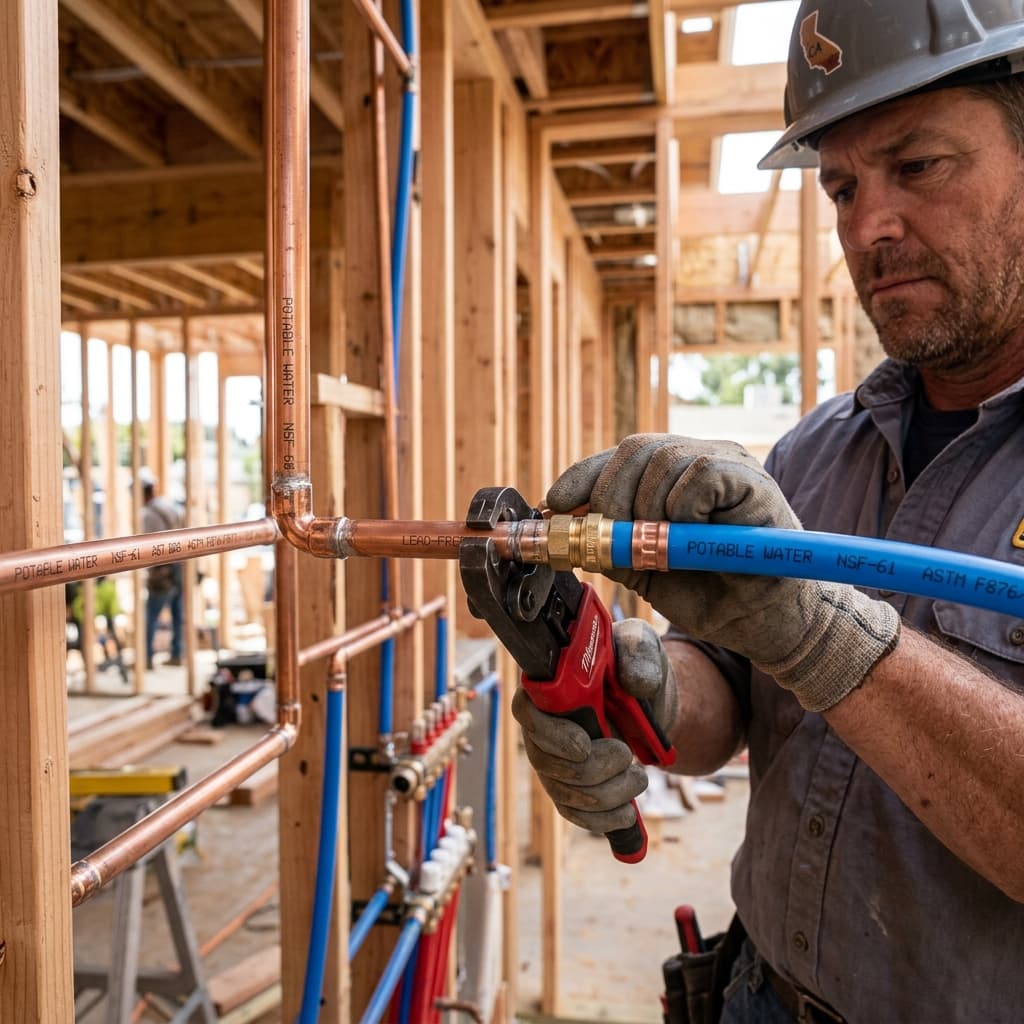
Drinking-water safe. Pipe, tube, fittings, solvent cement, thread sealant, solder and flux in a system that supplies drinking water must comply with NSF/ANSI/CAN 61 (604.1). Materials in the system should be alike, apart from valves and similar devices, unless the inspector approves otherwise. Table 604.1 lists which materials may be used for building supply piping and which for water distribution piping. They are two separate columns, so check both. Lead. Pipe, fittings and fixtures that carry drinking water can have a weighted average of no more than 0.25 percent lead on wetted surfaces. Solder and flux can have no more than 0.2 percent (604.2). This matches California Health and Safety Code Sections 116875 and 116876. Copper weight. Copper water tube must be at least Type L. Type M is allowed above ground in or on a building, or underground outside of a structure (604.3). Hard-drawn tube is color-coded: Type K green, Type L blue, Type M red (604.4). Used pipe. Pipe that was ever used for something other than potable water can't be reused in a potable system (604.8). Plastic building supply. Approved plastic is allowed for building supply piping. If the metal pipe you're replacing was used for electrical grounding, the replacement has to be a like material (604.10). Connector lengths. Flexible corrugated copper or stainless connectors are capped at 30 inches for fixtures, 72 inches for washing machines, and 120 inches for dishwashers and icemakers (604.12). Metallic flexible connectors on a water heater can't exceed 24 inches. PEX, PE-RT and similar tubing can't be installed in the first 18 inches of piping connected to a water heater (604.13). California-specific. CPVC is not permitted for potable water in OSHPD-regulated facilities (604.1 exception). In residential buildings, the local building official approves CPVC by permit under the conditions in 604.1.1. For the state agencies that adopt it, PEX-AL-PEX isn't adopted for potable water (604.13).Pressure: Section 608
- If the supply can't deliver at least 15 psi of residual pressure at the fixtures after friction and other losses, a tank and pump or another means must make up the difference (608.1).
- If static pressure exceeds 80 psi, install an approved pressure regulator with a strainer ahead of it and bring the pressure down to 80 psi or less. The regulator must meet ASSE 1003 or AWWA C530. Regulators 1-1/2 inches and larger don't need a strainer (608.2).
Installation and testing: Section 609
- Support water piping per Table 313.3, and ream burred ends to full bore (609.1).
- Same trench as a sewer. If the sewer or drain is clay, or another material not approved for use inside a building, the water pipe goes on a solid shelf at least 12 inches above the top of the sewer and 12 inches to one side. Where a water pipe crosses such a sewer, it must be at least 12 inches above it (609.2).
- Under a slab. Ferrous pipe needs an approved protective coating, and galvanizing doesn't count. Copper should run without joints where possible. Where joints are allowed, they are brazed with wrought copper fittings (609.3).
- Testing. Test with water at no less than the system's working pressure, or with air at a minimum of 50 psi. The system has to hold without leaking for at least 15 minutes. Plastic pipe is not air-tested, except PEX, PP or PE-RT where the manufacturer allows it (609.4).
Sizing: Section 610
- Each fixture's demand is expressed in water supply fixture units from Table 610.3. Those values already include both hot and cold water (610.3).
- Systems within its range can be sized from Table 610.4. Otherwise size them by the procedure in Appendix A, with Appendices C and M as alternatives (610.4, 610.5).
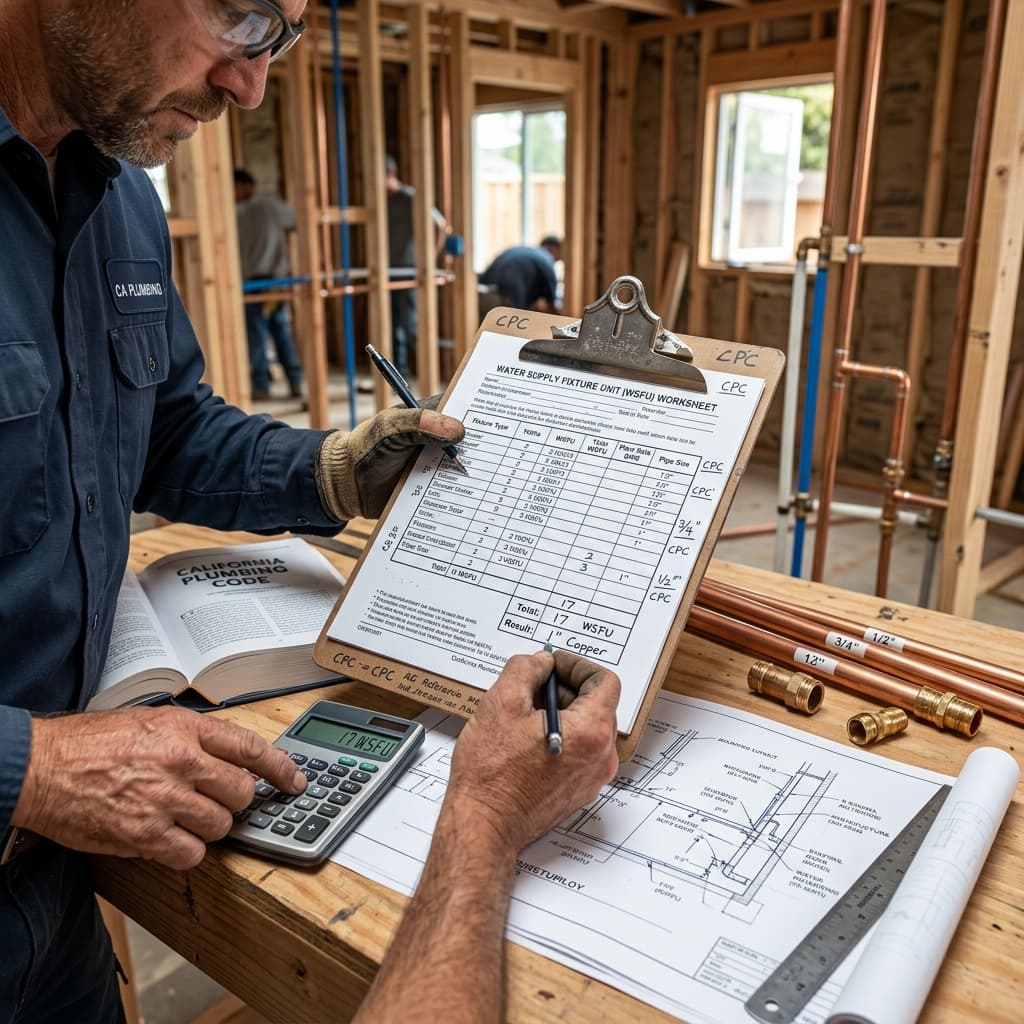
- The Table 610.4 method (610.8) works like this. Start from the pressure available at the meter. Adjust it by 1/2 psi for every foot of elevation between the source and the highest outlet. Pick the pressure range and the length column that is equal to or longer than your run. Then read down to a fixture-unit value at or above your total. The meter and building supply sizes are in the two left-hand columns.
How to study this for a closed-book exam
The C-36 trade exam doesn't let you bring the code in, so the sorting has to be automatic. A quick way to drill it: for each number above, say out loud which chapter it lives in before you say the value. 80 psi is Chapter 6 (608.2). Type L is 604.3. Table 422.1 is fixture counts. If you catch yourself putting a pipe rule under 422, stop and fix it, because the wrong answer choices on the exam are built from exactly that kind of mix-up.
Sources
- 2025 California Plumbing Code (California Code of Regulations, Title 24, Part 5), IAPMO read-only edition: Sections 422, 604, 608, 609 and 610. epubs.iapmo.org/2025/CPC
- California Health and Safety Code Sections 116875 and 116876 (lead content), as referenced in CPC 604.2.
---