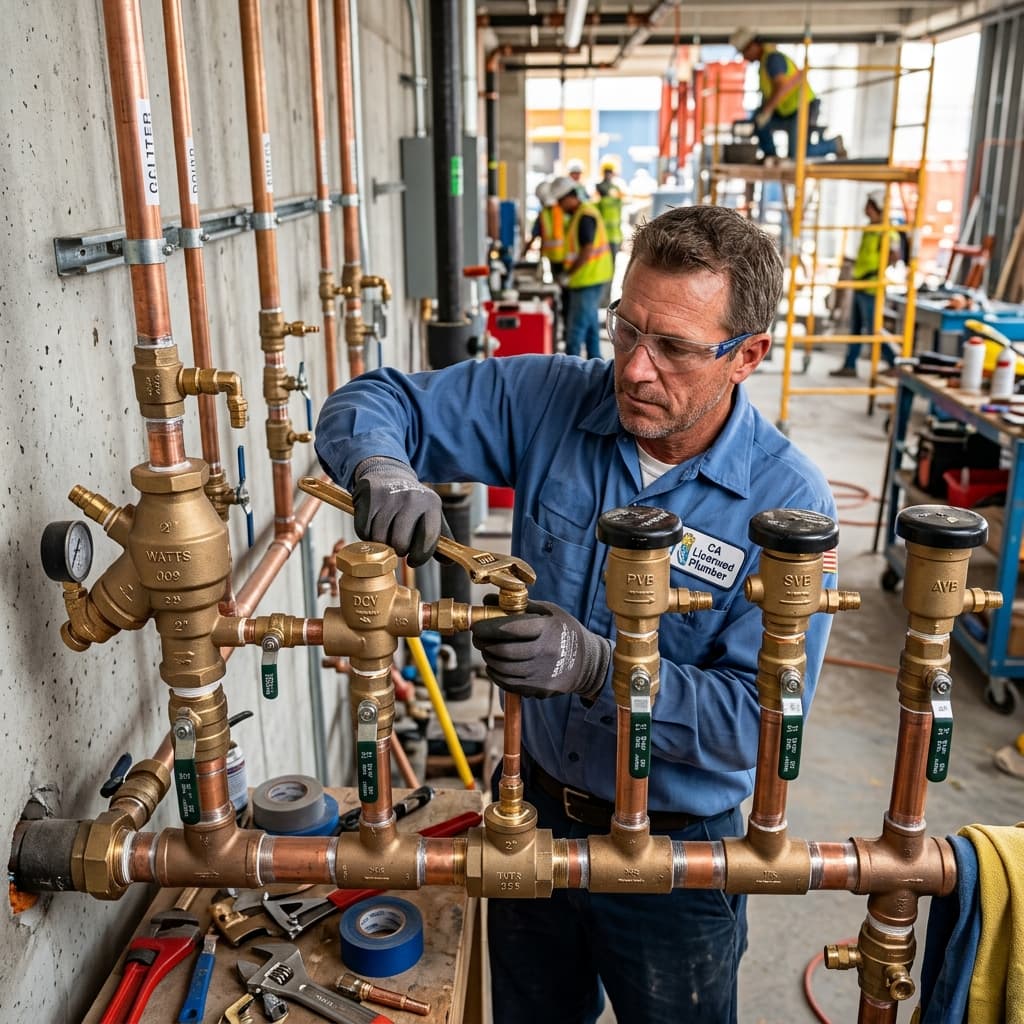
# Backflow Prevention Device Selection and Testing Requirements for C-36 Exam Success
Backflow prevention device california regulations represent a critical component of the C-36 plumbing license examination. As a contractor preparing for the Contractors State License Board (CSLB) exam, understanding the selection criteria and testing requirements outlined in the California Plumbing Code (CPC) Section 608 is essential for both passing the exam and protecting public health in your professional practice.
This comprehensive guide walks you through every aspect of backflow prevention devices, from device types and selection criteria to testing protocols and certification requirements.
Understanding Backflow Prevention: The Foundation
Before diving into device selection, let's establish why backflow prevention matters. Backflow occurs when water reverses direction in a plumbing system, potentially allowing contaminated water to mix with the potable water supply. This represents a significant public health hazard, which is why the CPC strictly regulates backflow prevention.
What Is Backflow?
Backflow happens through two primary mechanisms:
Back-siphonage occurs when water pressure in the potable water line drops below atmospheric pressure, creating a vacuum that pulls contaminated water backward into the system. Back-pressure happens when downstream pressure exceeds upstream pressure, forcing contaminated water backward into the main supply line.Understanding these mechanisms helps you recognize which device types are appropriate for specific hazard levels.
CPC Section 608: The Regulatory Framework
The California Plumbing Code Section 608 establishes the legal requirements for backflow prevention throughout California. This section mandates:
- Identification of potential backflow hazards
- Selection of appropriate prevention devices
- Installation location and configuration requirements
- Testing and certification protocols
- Record-keeping and reporting obligations
For C-36 exam success, you must thoroughly understand Section 608's requirements and how they apply to various installation scenarios.
The Five Types of Backflow Prevention Devices
The CPC recognizes five primary backflow prevention device types, each suited to different hazard levels and installation scenarios. Understanding these distinctions is crucial for the exam.
1. Air Gap
An air gap is the most reliable backflow prevention method. It's a physical separation between the potable water supply outlet and any potential contamination source, with a vertical distance of at least twice the diameter of the water supply pipe, but never less than 1 inch. Key characteristics:- Provides protection against both back-siphonage and back-pressure
- No moving parts; therefore no maintenance required
- Cannot fail mechanically
- Often used in lavatory sinks, toilet tank fill tubes, and emergency eyewash stations
2. Vacuum Breaker (Non-Pressure Type)
A vacuum breaker is a simple, inexpensive device that protects against back-siphonage only, not back-pressure.
Types include:- Atmospheric vacuum breakers - externally loaded, typically used on outdoor hose bibs
- Poppet-type vacuum breakers - internally loaded, common on kitchen sink spray attachments
- Cannot be installed in applications subject to continuous pressure
- Must be installed at the highest point of the water line it protects
- Requires annual testing
- Generally used for low-hazard conditions
3. Pressure Vacuum Breaker Assembly (PVB)
A pressure vacuum breaker assembly combines an external check valve with an internal air inlet valve, protecting against both back-siphonage and low-level back-pressure.
Key characteristics:- Can operate under continuous pressure
- Requires annual certification testing per CPC Section 608.2
- Must be located above the highest water outlet it serves
- Typically used for landscape irrigation systems and some industrial applications
- Must have isolation ball valves upstream and downstream
- Requires a test cock for certification testing
- Cannot be located in areas subject to freezing
4. Reduced Pressure Principle (RPP) Backflow Preventer
An RPP device is a dual-check valve assembly with an intermediate pressure chamber that vents through an external relief valve. It provides the highest level of protection against both back-siphonage and back-pressure.
Key characteristics:- Most comprehensive protection available
- Can be installed in any position
- Requires annual certification testing
- Provides continuous monitoring with relief valve discharge indicating system problems
- Used for high-hazard situations including medical gas systems, pesticide applications, and boiler connections
5. Double Check Valve (DCV) Assembly
A double check valve assembly consists of two independently operating check valves that protect against back-pressure and low-level back-siphonage but provides less protection than an RPP device.
Key characteristics:- Simpler and less expensive than RPP devices
- Requires annual testing in most jurisdictions
- Suitable for moderate-hazard applications
- Can be installed in any position
- Commonly used for fire suppression systems and lawn irrigation
Hazard Classification and Device Selection
The CPC classifies water uses into high-hazard and low-hazard categories. Your device selection must match the hazard level.High-Hazard Conditions
High-hazard situations involve potential contact with biologically hazardous, radioactive, or toxic substances. Examples include:
- Medical gas systems
- Pesticide injection systems
- Boiler or hot water heater connections with additives
- Wastewater reclamation systems
- Laboratory or medical facility connections
Low-Hazard Conditions
Low-hazard situations involve potential contamination with non-toxic substances. Examples include:
- Landscape irrigation systems
- Lawn sprinkler systems
- Swimming pools and spas
- Toilet tank fill tubes
- Food service connections without chemical additives
Backflow Preventer Testing Requirements
The CPC Section 608.2 establishes specific testing requirements that differ based on device type.
Annual Certification Testing
Devices requiring annual testing:- RPP backflow preventers
- Pressure vacuum breaker assemblies
- Double check valve assemblies
- Some detector check valves
- Must be performed by a California-certified backflow prevention device tester
- Testing must follow the standards outlined in the American Society of Sanitary Engineers (ASSE) 2000 Series Standards or equivalent
- Results must be documented on approved forms
- Records must be maintained for a minimum of three years
Test Frequency Schedules
Different device types have different testing intervals:
| Device Type | Initial Test | Subsequent Tests | Notes | |---|---|---|---| | RPP | 60 days after installation | Annually | Most frequent testing | | PVB | 60 days after installation | Annually | Cannot be used in frozen areas | | DCV | 60 days after installation | Annually | Annual certification required | | Non-Pressure VB | Upon installation | Every 12 months | Less critical but still required | | Air Gap | N/A | Visual inspection only | No certification required |
CPC Section 608.2 specifies that all testable devices require documentation of testing results, with municipalities typically maintaining these records.Installation Location and Configuration
Proper installation is as critical as device selection. The CPC specifies precise requirements:
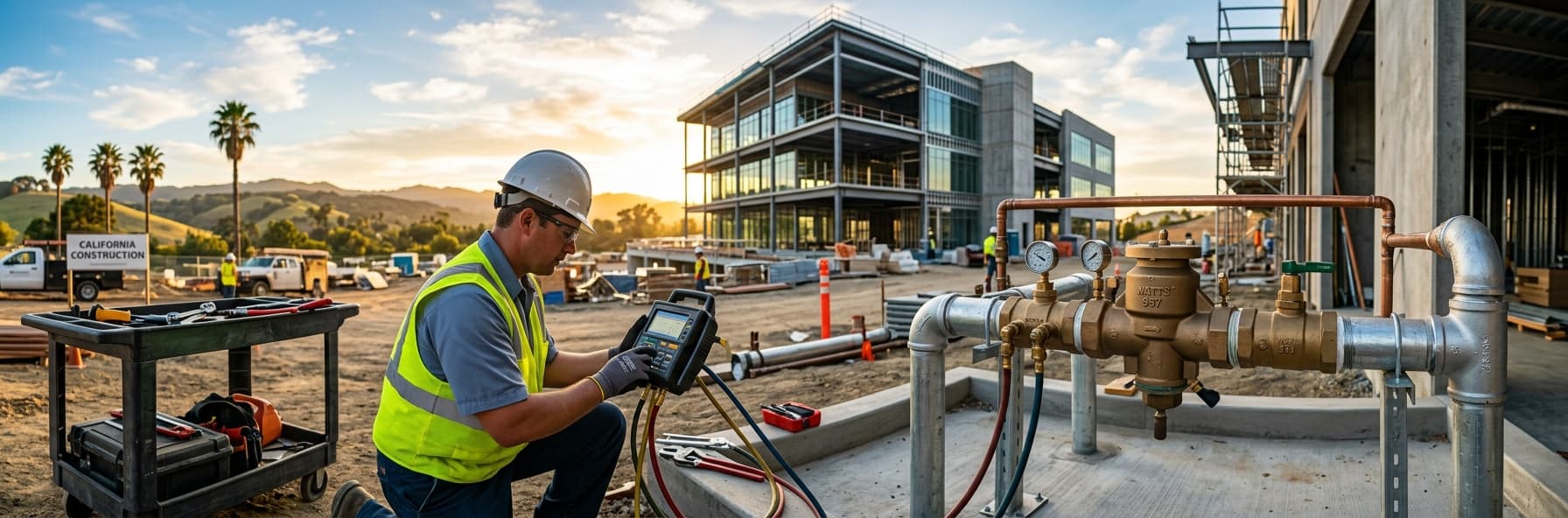
Upstream isolation: CPC Section 608.3.1 requires shut-off valves on both sides of the backflow preventer for maintenance and testing purposes. Downstream considerations: The device must be installed below the lowest water outlet it protects, except for pressure vacuum breaker assemblies, which must be above the highest outlet. Accessibility: Devices must be installed in accessible locations to permit testing and maintenance. Underground or inaccessible installations are prohibited unless the municipality grants specific approval. Drainage requirements: RPP devices with relief valves must have drainage provisions that don't create backpressure. The drain must terminate above the flood rim of a receptor or through an air gap.Device-Specific Testing Protocols
RPP Device Testing
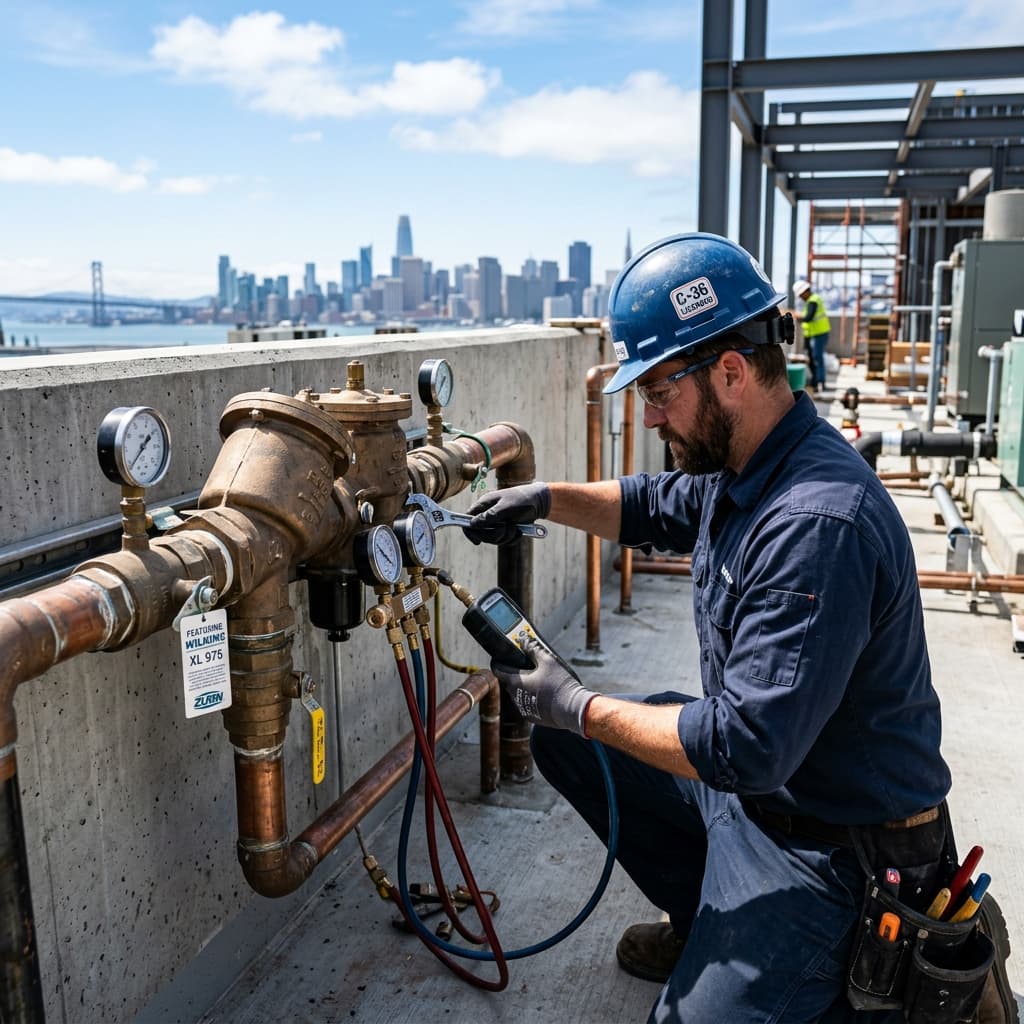
Testing an RPP device involves:
- Main check valve test - verifies the first check valve holds
- Relief valve operation test - confirms the relief valve opens at the correct pressure differential
- Second check valve test - verifies the second check valve holds
- Overall pressure loss test - measures acceptable pressure differential across the device
PVB Device Testing
PVB testing includes:
- Low-pressure closure test - verifies the check valve closes at minimal pressure differential
- Air inlet valve operation test - confirms the air inlet valve opens when pressure drops
DCV Device Testing
DCV testing involves:
- First check valve test - checks for proper sealing
- Second check valve test - confirms secondary protection
- Total pressure loss test - measures acceptable pressure differential
Common C-36 Exam Questions About Backflow Prevention
Understanding the types of exam questions helps you prepare effectively:
Scenario-based questions: "A customer wants to connect a pesticide injection system to their irrigation water supply. Which device is required by CPC Section 608?" Answer: An RPP backflow preventer, because pesticide injection represents a high-hazard condition requiring the highest level of protection. Code reference questions: "Under CPC Section 608.2, what is the required testing interval for a pressure vacuum breaker assembly?" Answer: Annual certification testing by a certified tester, with initial testing required within 60 days of installation. Device limitation questions: "Can a non-pressure vacuum breaker be used on a pressurized lawn irrigation system?" Answer: No. Non-pressure vacuum breakers can only be used on non-pressurized applications, as they cannot withstand continuous pressure.Study Tips for Exam Success
- Create flashcards for each device type, including: protection level (back-siphonage, back-pressure, or both), testing frequency, installation restrictions, and typical applications.
- Memorize the five device types in order of protection level: Air Gap (highest), RPP, PVB, DCV, and Non-Pressure VB (lowest).
- Practice scenario questions that require you to identify appropriate devices based on hazard levels and specific conditions.
- Review CPC Section 608 thoroughly, focusing on Sections 608.1 through 608.3, which contain the specific requirements you'll encounter on the exam.
- Understand the distinction between high-hazard and low-hazard applications, as this determines device selection in nearly every scenario question.
- Learn the test frequency schedule by memorization, as this knowledge is frequently tested.
Conclusion
Mastery of backflow prevention device selection and testing requirements is essential for C-36 exam success. The California Plumbing Code Section 608 establishes clear requirements that protect public health by preventing contaminated water from entering the potable supply system. By understanding the five device types, their appropriate applications, hazard classifications, testing protocols, and CPC requirements, you'll be well-prepared for the exam and equipped to protect public health in your professional practice.
Focus your studying on the distinction between device types, the hazard-based selection process, and the specific testing frequencies outlined in CPC Section 608.2. With dedicated study and practice, you'll master this critical area of the C-36 examination.